Wu Song武松
Tiger Slayer
The tiger is only the beginning.
The warning is real. Going back would be embarrassing. Wu Song keeps walking.
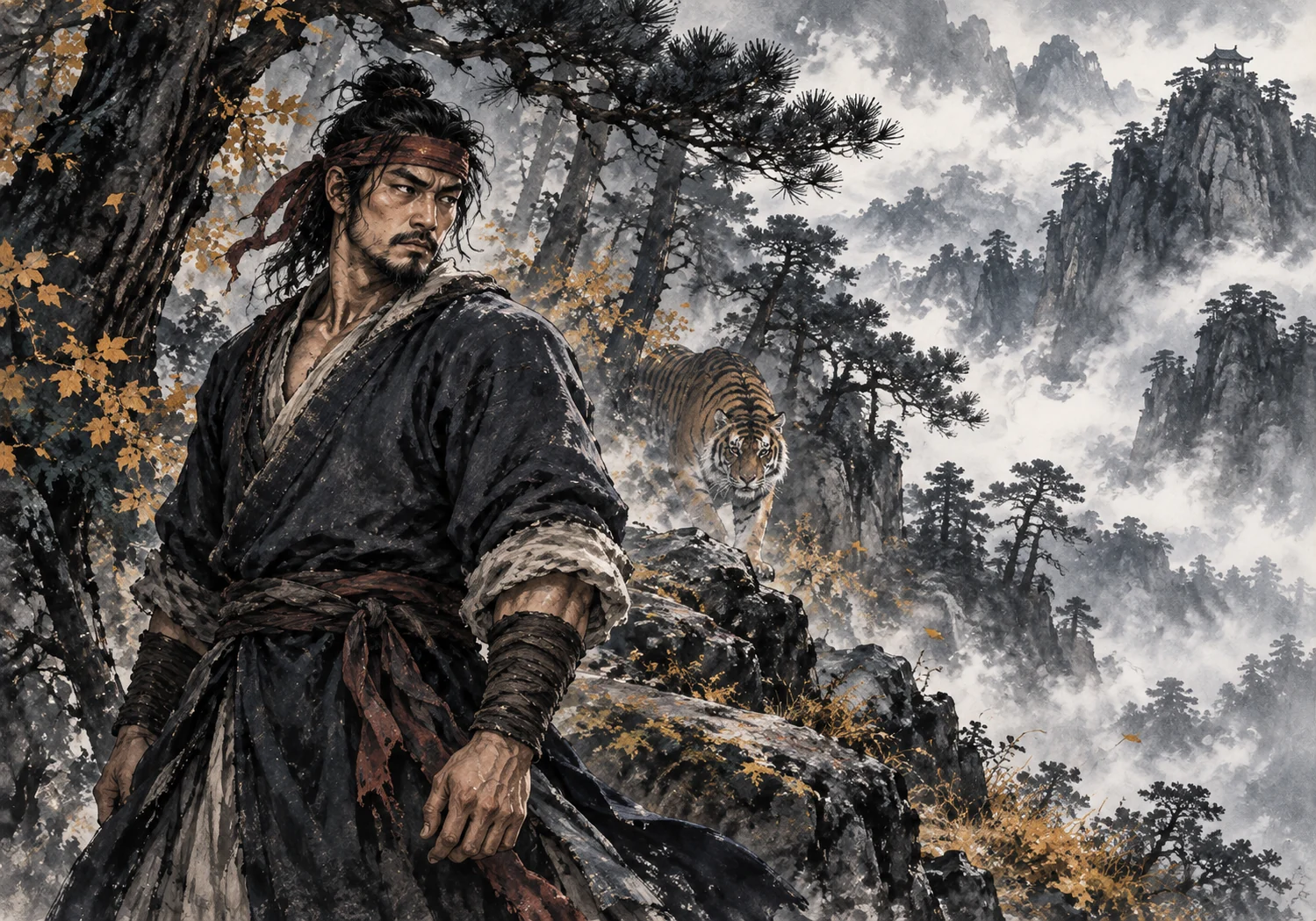
The ridge beyond the inn
The inn’s sign warns that three bowls of its wine are enough to stop a traveler crossing the ridge. Wu Song drinks more and prepares to leave. The innkeeper warns him about a man-eating tiger. He suspects the man is trying to sell him a night’s lodging.
Farther on, an official notice confirms the danger. Now he believes it. But going back would mean facing the innkeeper he dismissed. He walks on alone.
The tiger arrives with a rush of wind. Wu Song dodges its attacks before striking back. His staff hits a tree and breaks. At close quarters he grabs the animal, pins it down, and beats it with his fist. When the struggle is over, he is too exhausted to carry the carcass away.
The villagers gain a safer road, and Wu Song gains fame and a constable’s post. Only then does he return to the company of his elder brother, Wu Dalang.
The brother he cannot bring back
Wu Dalang sells steamed food. For a time, the brothers have a home together. Then official business takes Wu Song away. Wu Dalang discovers that his wife, Pan Jinlian, is involved with Ximen Qing. The plot to silence him ends in poisoning.
Wu Song returns to a death already explained away. He investigates, gathers evidence, and tries to obtain official redress. The attempt fails. He kills Pan Jinlian and Ximen Qing himself, then surrenders.
Exile and further betrayals follow. His later revenge reaches people beyond the original wrongdoers. A Buddhist traveler’s disguise eventually helps him escape toward the outlaw world. The celebrated tiger slayer has become a man whose grief and violence cannot be neatly separated.
Two kinds of danger
On the ridge, the danger has a body he can seize. The fight has an end. At home, strength comes too late: the person he wants to protect is already dead.
That is what makes the famous feat an opening rather than a complete portrait. Wu Song can be courageous, proud, bereaved, and cruel at different points in the same life. Keeping his story means remembering the frightened struggle as well as the triumph, and the victims as well as his loss.
Where does justice end and vengeance begin?
What part of Wu Song’s story stays with you?
Reading Wu Song.
Where does Wu Song kill the tiger?
On Jingyang Ridge, near Yanggu County. He crosses alone after drinking and ignoring an innkeeper’s warning.
Is Wu Song already a Liangshan outlaw during the tiger fight?
No. The tiger fight comes earlier. His official work, family loss, exile, and later betrayals precede his eventual membership in the brotherhood.
Written by Liangshan Lore, based on Water Margin (Shuihu Zhuan), traditionally attributed to Shi Nai’an. The novel follows an outlaw brotherhood in a fictionalized Song-dynasty setting. It is literature, not a record of each character’s historical life.
Chapter references below follow the 120-chapter Chinese edition. Other editions and English translations differ in chapter numbering, names, and endings. These are original English summaries, not quotations from a modern translation. The reflection above is our interpretation. Artwork is a concept illustration.
Read & listen in English.
John Zhu’s podcast offers his own English retelling, with readable transcripts and audio. Podcast episode numbers differ from the novel’s chapter numbers. The publisher pages below introduce published English translations.
Chinese original · text & chapter references
Primary-text references for checking the plot and edition. These pages are in Chinese.