Wu Song and the Tiger
The best-known image is the fist striking the tiger. The scene begins much earlier—with wine, a warning, and a traveler who does not want to admit he was wrong.
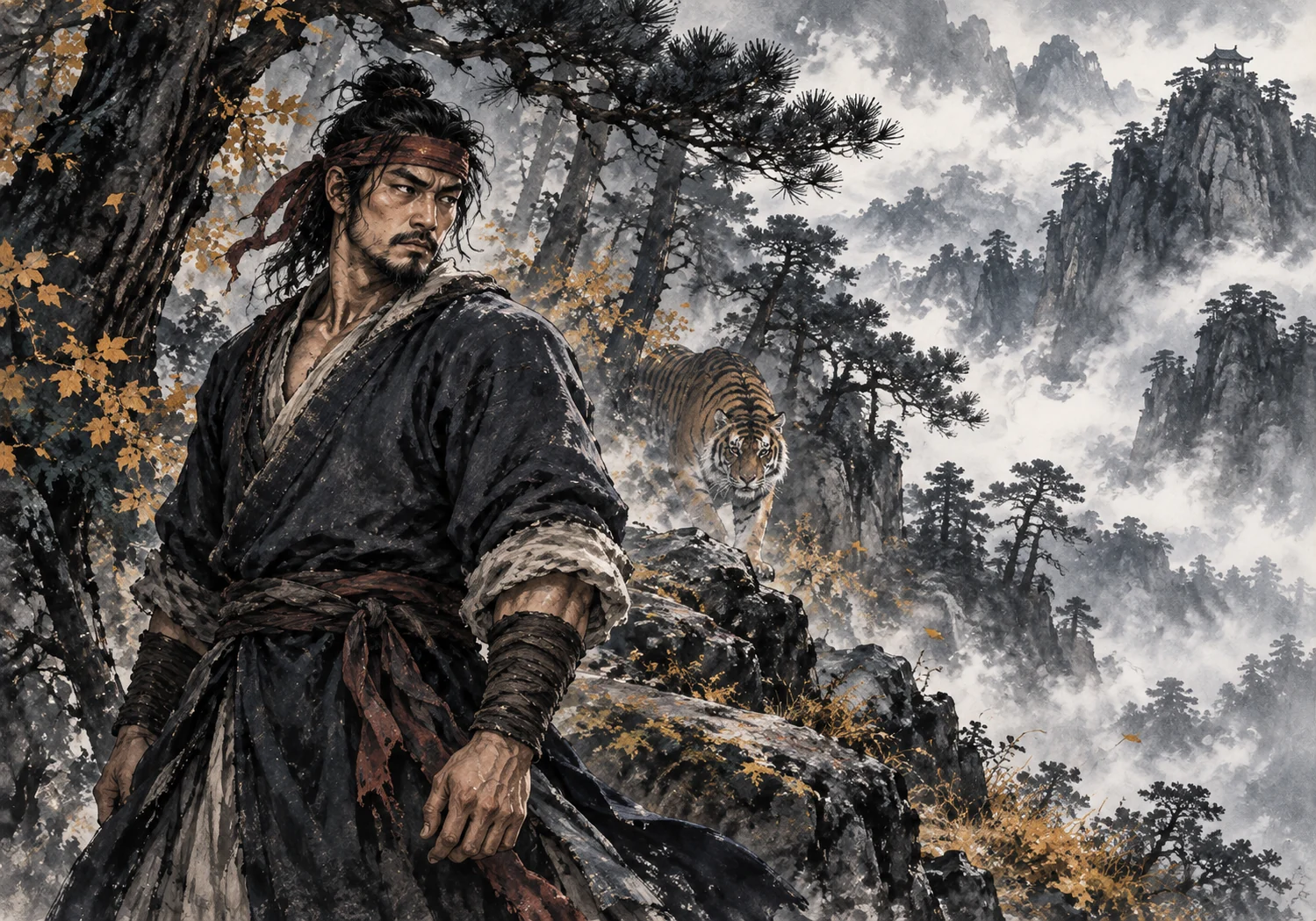
He gets two warnings
At the inn below Jingyang Ridge, Wu Song drinks past the limit advertised by the sign: three bowls are enough to stop a traveler crossing. When the innkeeper warns him about a tiger, he suspects a trick to keep him there for the night.
An official notice on the road confirms the danger. His excuse for disbelief is gone. Turning back would now mean returning to the innkeeper he dismissed, and he is ashamed to do that. He keeps walking alone.
This detail makes the opening recognizable without making the danger sensible. A small embarrassment has begun deciding a much larger risk.
First he dodges. Then the staff breaks.
The tiger arrives suddenly. Its first attacks demand evasion: Wu Song must get out of the way before he has any chance to strike. The scene spends time on survival before it gives us the famous feat.
He swings his staff, misses the animal, and hits a tree. The wood breaks. At close range, he seizes the tiger and holds it down, striking repeatedly with his fist. He uses the remaining piece of staff to finish the struggle.
Afterward, he cannot carry the carcass. The exhausting aftermath makes the victory feel earned. This is a frightened, resourceful man who has survived a terrible encounter, not an untouched figure posing beside an inevitable result.
Why the villagers care
The tiger has made the route dangerous for local people. Killing it removes a threat they have been living with. What began as Wu Song’s solitary struggle becomes a public relief.
He is celebrated and made a constable in Yanggu County. At this point, the feat brings him into official life; it does not send him to Liangshan.
His brother Wu Dalang’s death, the failed attempt to obtain justice, revenge, exile, and further betrayals come later. Keeping that sequence clear helps us see how much changes after his most famous success.
The victory does not settle the first decision
Wu Song shows courage once the tiger is upon him. He also had a credible reason not to go there alone. Admiring the fight does not require us to approve the choice that preceded it.
Those two responses can coexist. Relief at his survival makes the warnings easy to forget, but the story has deliberately placed them before the triumph. He becomes interesting through that imperfect judgment as well as through his strength.
Read for the changes in his confidence
Follow the scene from the innkeeper’s warning to the official notice, the sudden attack, the broken staff, and the exhausted walk away. Each stage changes what Wu Song knows and what he can do.
Then notice the villagers. They turn the aftermath into more than a story about one man’s pride. A dangerous route has become safer, even though the decision that led to the fight was reckless.
Chapter 23 is the primary scene. The English transcript and audio below offer a longer retelling; our character page continues into the family tragedy. These are ways into the fiction, rather than claims that the tiger encounter is documented history.
Does surviving a reckless choice make it a courageous one?
Which part of the story speaks to you? Tell us as we shape the complete 108-card collection.
Original English writing by Liangshan Lore, based on the Chinese novel Water Margin, traditionally attributed to Shi Nai’an. Plot references follow the 120-chapter Chinese edition; names, chapter numbering, and endings can vary between editions and translations. Sections marked “Our reading of the story” offer our interpretation. The characters and events belong to fiction; concept illustrations are not historical portraits.
Read & listen in English.
John Zhu’s podcast offers his own English retelling, with readable transcripts and audio. Podcast episode numbers differ from the novel’s chapter numbers. The publisher pages below introduce published English translations.
Chinese original · text & chapter references
Primary-text references for checking the plot and edition. These pages are in Chinese.
Wu SongTiger Slayer · illustrated character story Sun ErniangThe Female Yaksha · illustrated character story