Xiang Chong项充
Eight-Armed Nezha
He turns back at the stream. The road behind him is already closed.
Xiang Chong has spent years advancing behind a shield. Near Muzhou, one pursuit carries him across the water and beyond the army that can cover his return.
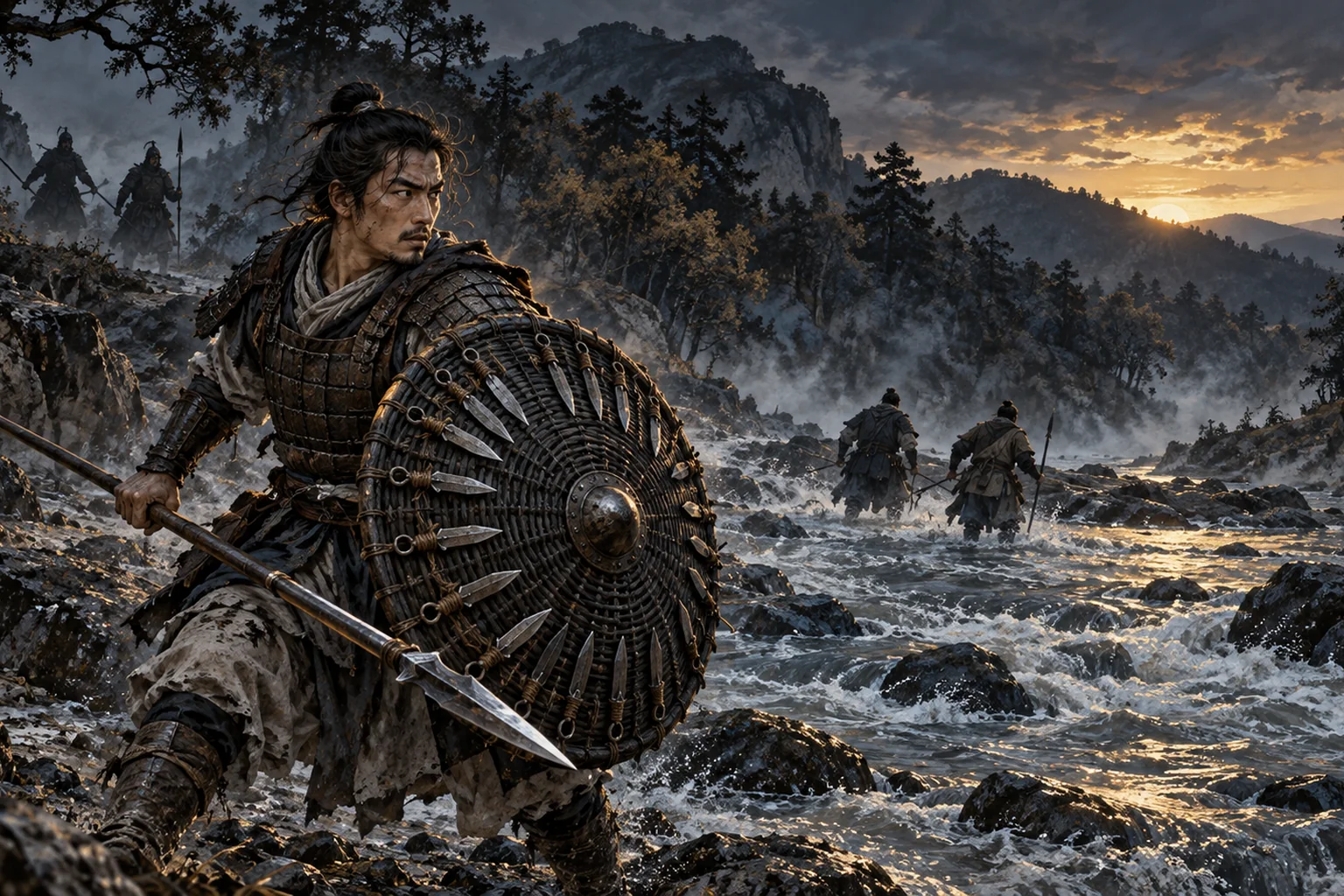
Twenty-four knives around a shield
Xiang Chong is one of three chiefs at Mangdang Mountain. Fan Rui leads roughly three thousand followers; Xiang Chong and Li Gun command beside him. The mountain group intends to challenge Liangshan rather than ask to join it.
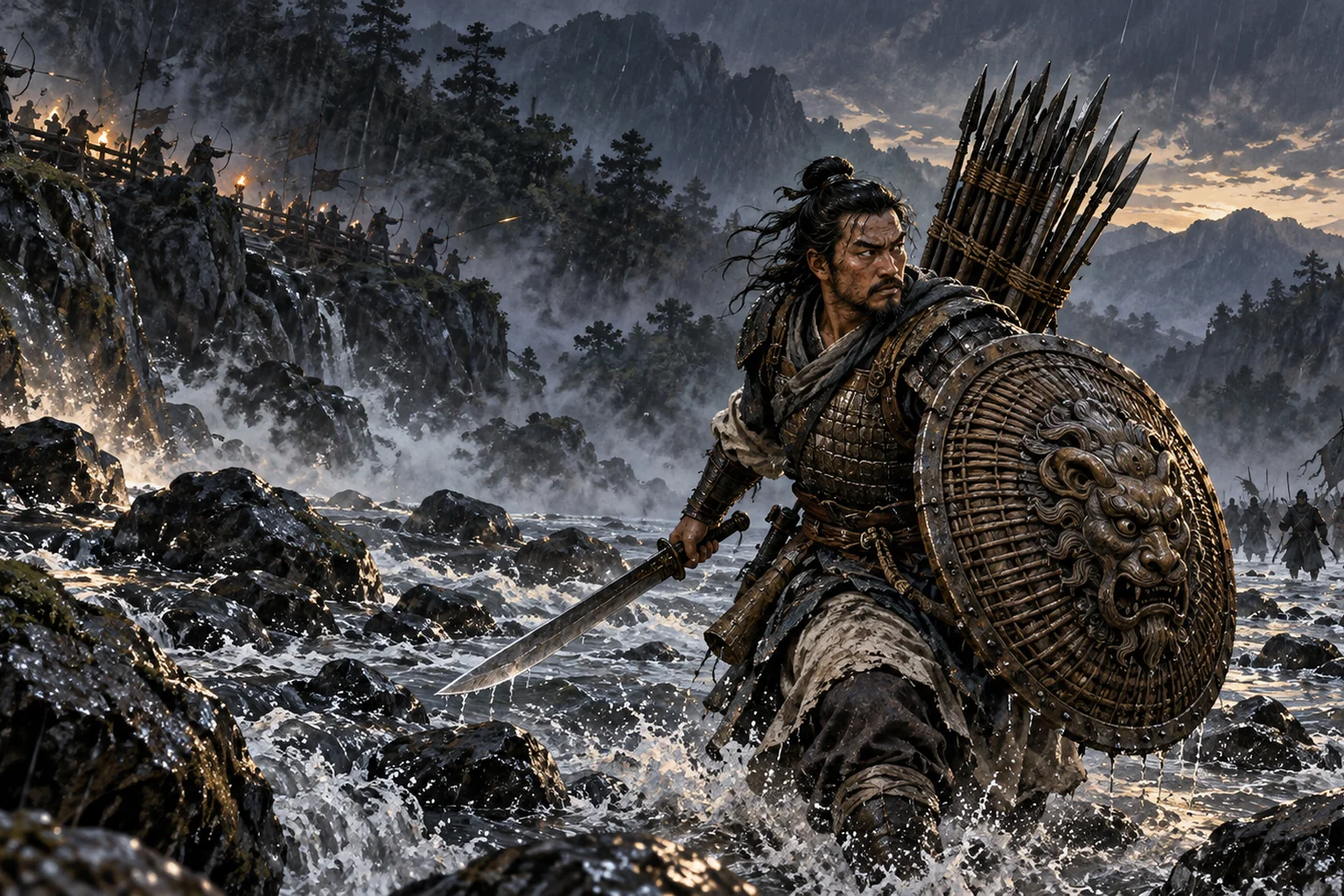
Xiang Chong fights on foot with an iron javelin in one hand and a shield in the other. Twenty-four flying knives are fitted around the shield. The novel describes him striking at a hundred paces. The crowded weaponry gives him the name Eight-Armed Nezha, after the many-armed deity; Xiang Chong himself does not have supernatural arms.
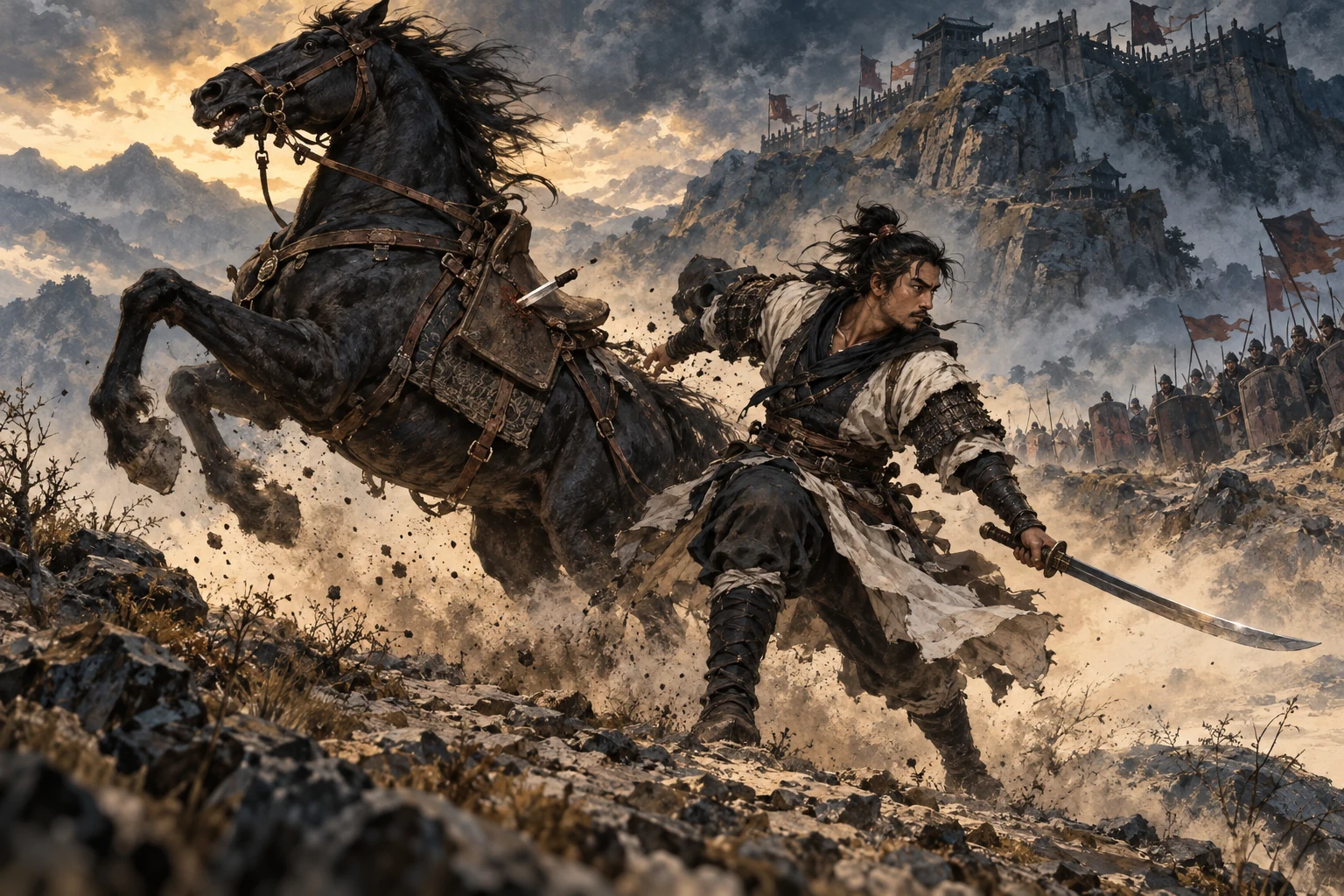
When Shi Jin brings the first Liangshan force to Mangdang Mountain, Xiang Chong and Li Gun do not wait for a formal exchange. They raise their shields and drive into the line. The attack breaks the rear ranks, sends the force running and leaves Yang Chun on foot after a flying knife strikes his horse.
Released without a hostage
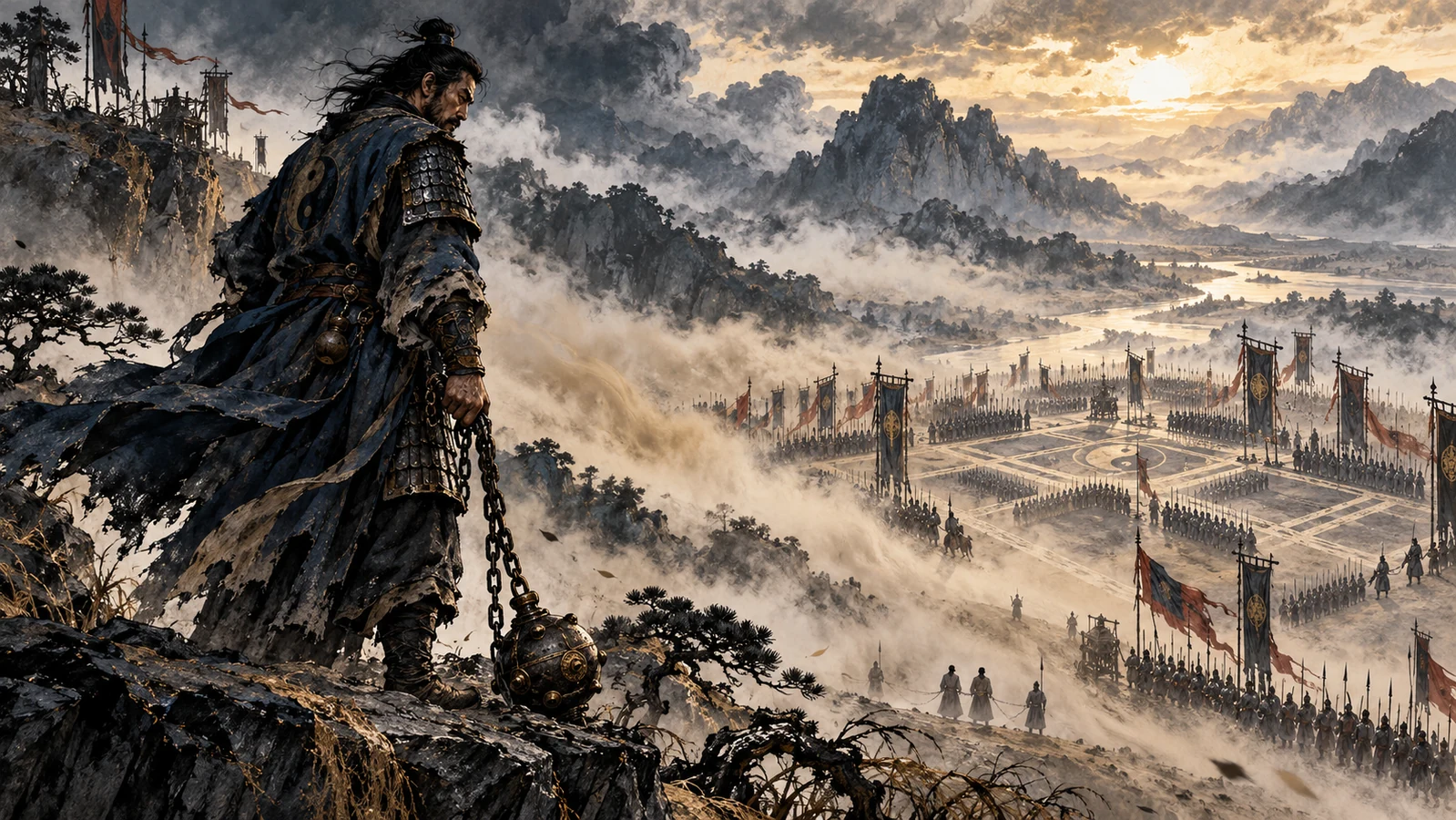
Liangshan returns with a formation prepared by Gongsun Sheng. Fan Rui calls up wind and sand, and Xiang Chong and Li Gun lead five hundred swordsmen toward an opening. Most are stopped by arrows and bolts; only about fifty enter with the two chiefs.
Inside, the formation changes. Wind and darkness follow the pair while the soldiers turn to meet each attempt at escape. Unable to find a route, Xiang Chong and Li Gun step onto ground prepared to collapse. Hooks pull them from the pit and they are taken before Song Jiang.
Song Jiang has both men untied. He gives them food, clothes, horses and their weapons, then allows both to return without keeping either as a hostage. Xiang Chong and Li Gun carry the invitation back up the mountain. Fan Rui accepts it, and the three chiefs burn their stronghold and join Liangshan.
The shield works inside a formation
Xiang Chong’s strength is never only the shield. At Mangdang Mountain he moves with Li Gun and a following line; at Liangshan the two become shield-bearers who cover Li Kui’s rush. The equipment matters because people move behind and beside it.
At the assembly, Xiang Chong ranks sixty-fourth as the Earthly Flying Star and serves among the infantry commanders. In later campaigns he repeatedly appears with Li Gun, Fan Rui, Li Kui and Bao Xu. His card-like image is a man packed with weapons, but the story keeps placing that image inside a team.
Near Muzhou, Xiang Chong and Li Gun again shield Li Kui during a pursuit of Zheng Biao. The three cross a stream into unfamiliar ground, and enemy troops cut off the rest of the force. Xiang Chong turns back, finds the bank blocked and is tripped by a rope as he tries to descend. Surrounded soldiers kill him before the others can return. The shield remains in his hands; the formation around it is gone.
What protection stops working when the group carrying it breaks apart?
What part of Xiang Chong’s story stays with you?
Reading Xiang Chong.
Who is Xiang Chong in Water Margin?
Xiang Chong is a shield-bearing bandit chief at Mangdang Mountain and Liangshan infantry commander, known as Eight-Armed Nezha. The novel places this character 64 in the assembly of the 108 heroes. That rank is not a judgment of moral worth.
Why is Xiang Chong called Eight-Armed Nezha?
The nickname refers to his many-weapon fighting style, not literal extra arms. Xiang Chong carries an iron javelin and a shield fitted with twenty-four flying knives, recalling the many-armed deity Nezha.
Published · Updated
Written by Liangshan Lore, based on Water Margin (Shuihu Zhuan), traditionally attributed to Shi Nai’an. The novel follows an outlaw brotherhood in a fictionalized Song-dynasty setting. It is literature, not a record of each character’s historical life.
Chapter references below follow the 120-chapter Chinese edition. Other editions and English translations differ in chapter numbering, names, and endings. These are original English summaries, not quotations from a modern translation. The reflection above is our interpretation. Artwork is a concept illustration.
Continue in English.
These credited resources offer further reading, listening, publication context, or museum evidence. Chinese Lore is an English retelling with transcripts and audio, not a line-by-line translation; podcast episode numbers differ from novel chapters.
Chinese original · text & chapter references
Primary-text references for checking the plot and edition. These pages are in Chinese.