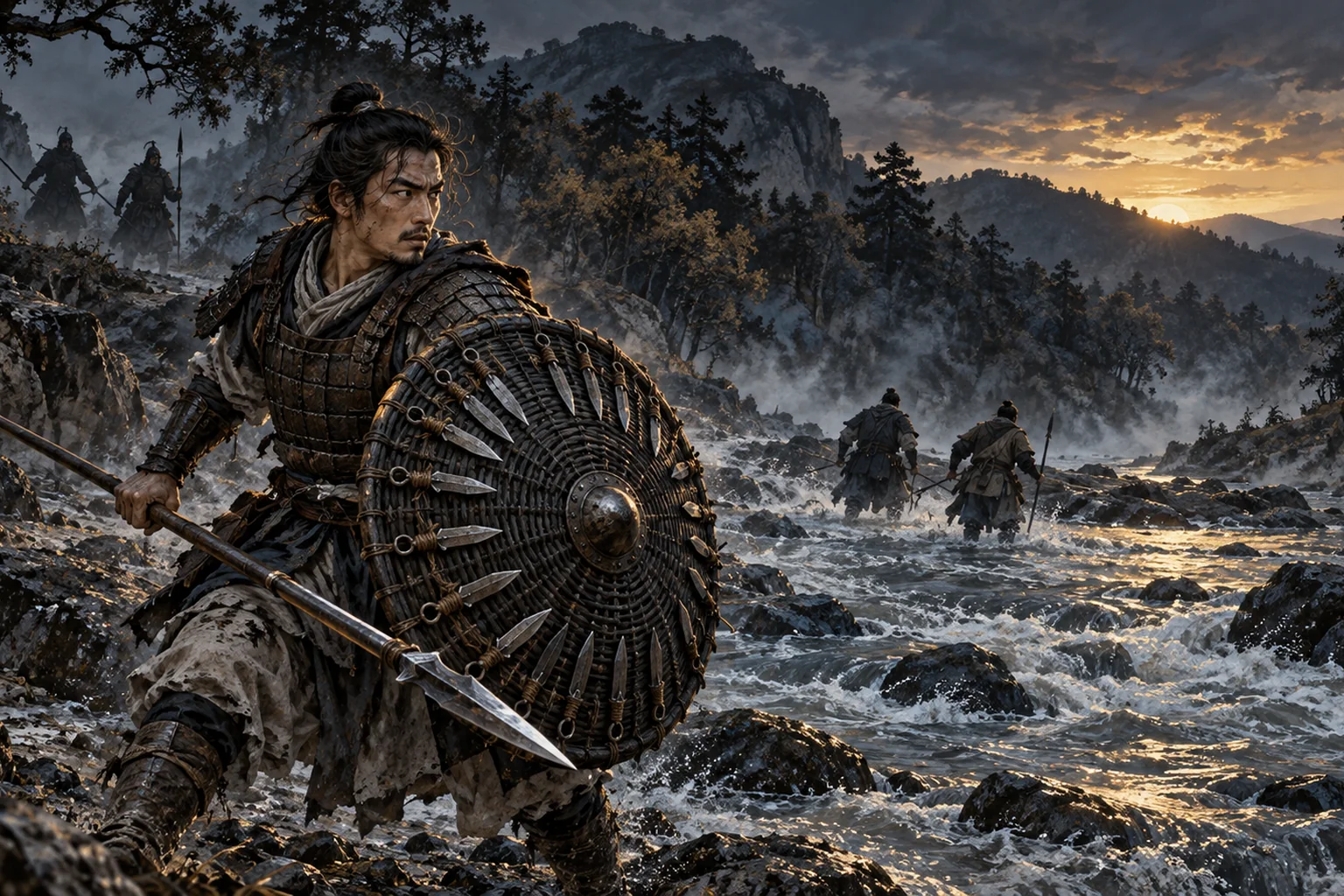
Bao Xu鲍旭
God of Death
The charge works—until the order to stop cannot reach him.
Bao Xu cuts down the officer guarding two prisoners and opens their cart. Years later, he runs through a city gate after the army has begun to retreat.
A chief among dead trees
Before Bao Xu appears, Jiao Ting describes him to Li Kui. He leads a band at Deadwood Mountain, robs travelers and is known for killing. The reputation earns him the name God of Death. The novel does not offer an earlier profession or a story that softens how he lives.
Li Kui has left Liangshan after an argument with Song Jiang and wants to prove himself by attacking Lingzhou. Jiao Ting takes him toward Deadwood Mountain. Bao Xu receives Li Kui as a brother, agrees to join Liangshan and brings his own followers into the plan.
The meeting gives Bao Xu a larger company without asking him to become a different kind of man. He enters the brotherhood through the same capacity for violence that made his mountain name.
The lock on the prisoner cart
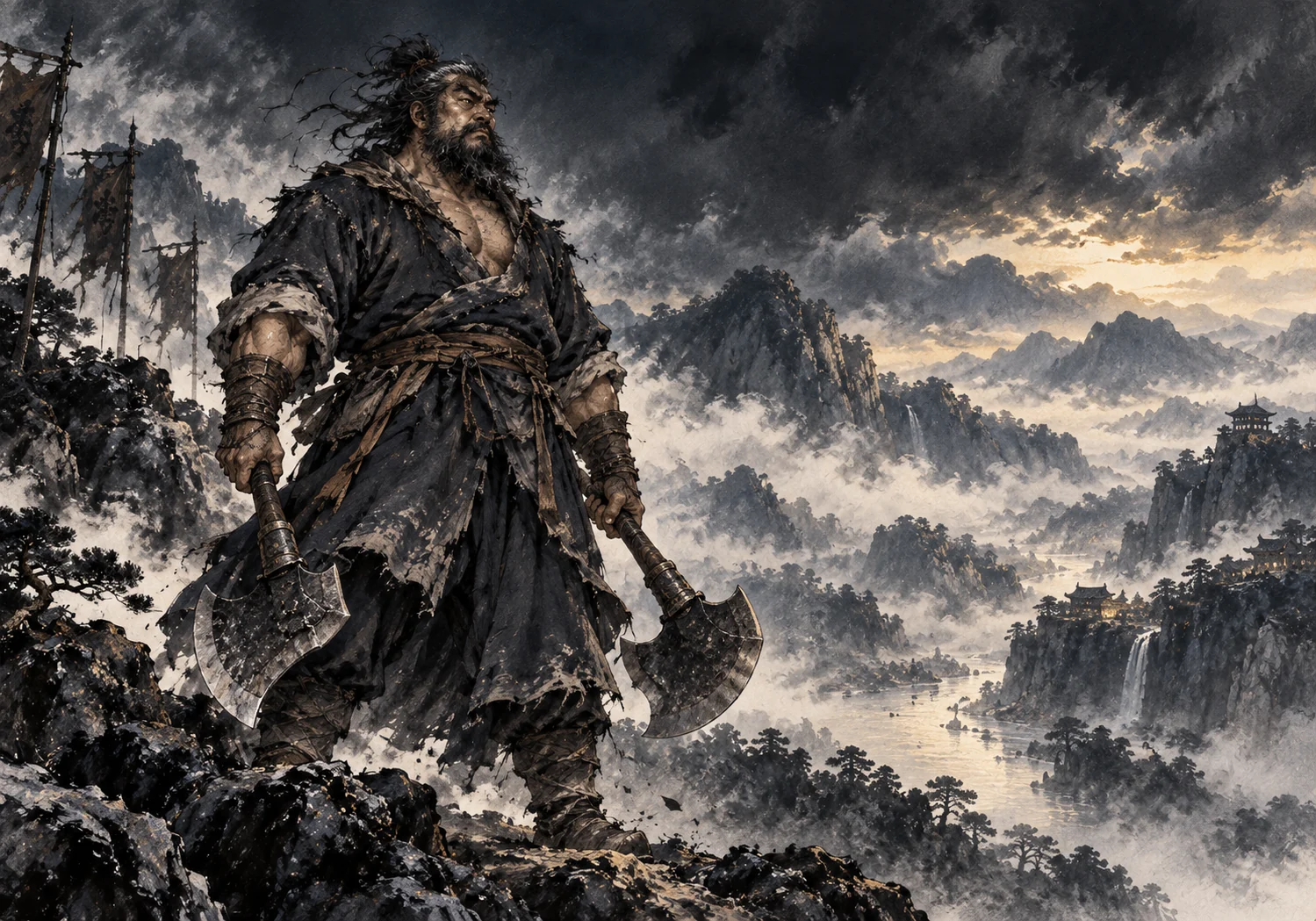
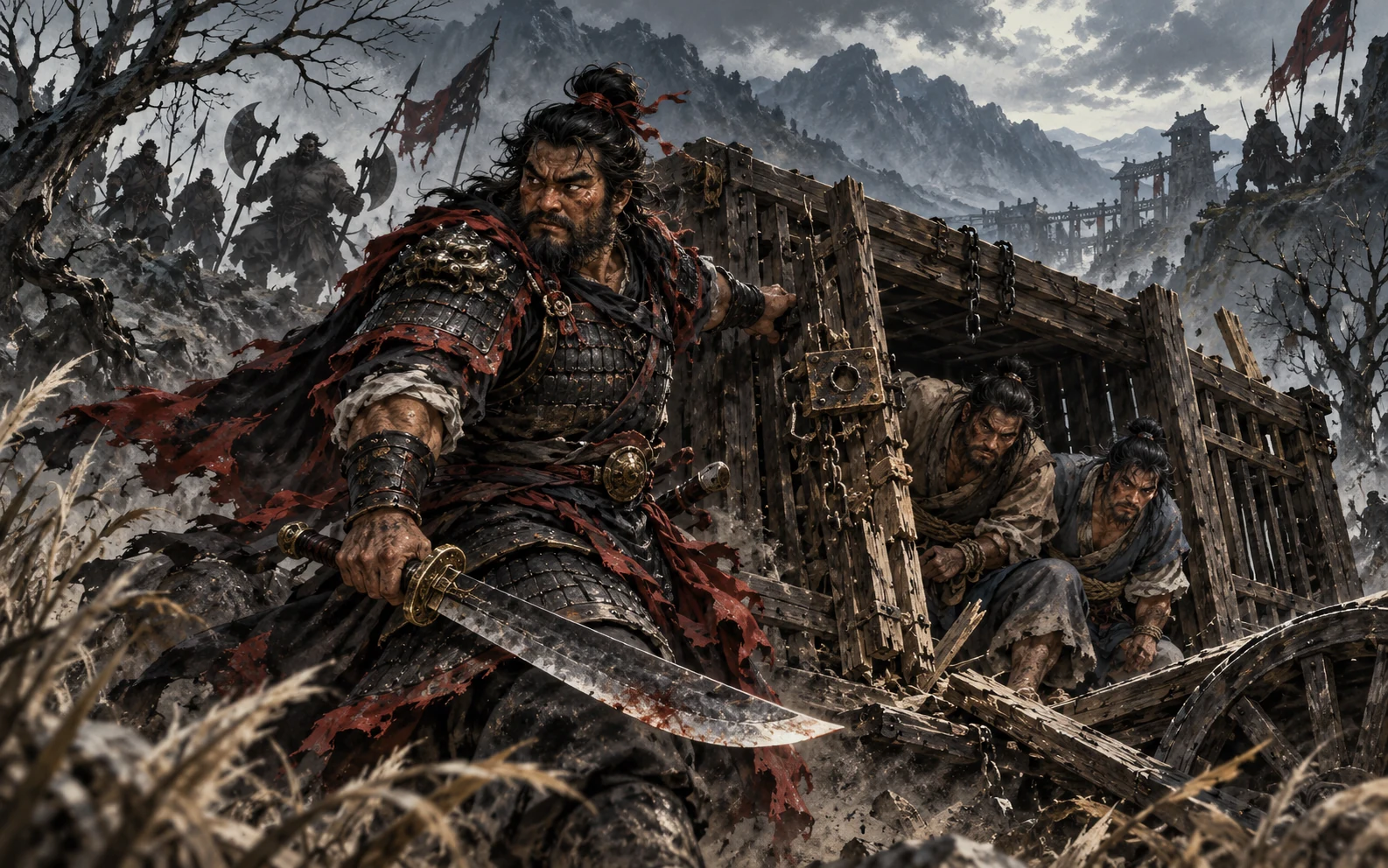
Lingzhou’s commanders capture Xuan Zan and Hao Siwen and send them toward the capital in wooden prisoner carts. At Deadwood Mountain, Li Kui and Jiao Ting block the road. Bao Xu attacks from behind, kills the escorting officer with one stroke of his broad saber and sends the remaining guards running.
The carts are opened. The rescued men ask Bao Xu to bring his followers into the campaign against Lingzhou, and the Deadwood Mountain group joins the fighting. Bao Xu’s first named action saves two members of the company he is about to enter.
At the assembly, he ranks sixtieth as the Earthly Savage Star and serves among the infantry commanders. He later fights in the close company of Li Kui, Xiang Chong and Li Gun—a formation built to keep moving into the enemy line.
A force without a stopping distance
The prisoner-cart rescue shows why the brotherhood values Bao Xu. He commits immediately, breaks an armed convoy and turns danger into reinforcement. The same momentum becomes harder to separate from its cost.
Outside Hangzhou, Li Kui, Bao Xu, Xiang Chong and Li Gun drink before promising to capture the rebel commander Shi Bao. Bao Xu kills one opposing officer. When logs and stones force Song Jiang to order a retreat, Bao Xu has already driven through the gate.
Shi Bao is waiting inside and kills him. Bao Xu’s last charge is not a sudden reversal of character; it is the familiar action continuing beyond the point where the rest of the army can protect him. Li Kui returns in tears, and Wu Yong names Bao Xu as the price paid for the failed attack.
When does decisive action become an inability to stop?
What part of Bao Xu’s story stays with you?
Reading Bao Xu.
Who is Bao Xu in Water Margin?
Bao Xu is a deadwood Mountain bandit chief and Liangshan infantry leader, known as God of Death. The novel places this character 60 in the assembly of the 108 heroes. That rank is not a judgment of moral worth.
How does Bao Xu die in Water Margin?
During the campaign at Hangzhou, Bao Xu charges through the north gate after Song Jiang orders a retreat. The rebel commander Shi Bao is waiting inside and kills him.
Published · Updated
Written by Liangshan Lore, based on Water Margin (Shuihu Zhuan), traditionally attributed to Shi Nai’an. The novel follows an outlaw brotherhood in a fictionalized Song-dynasty setting. It is literature, not a record of each character’s historical life.
Chapter references below follow the 120-chapter Chinese edition. Other editions and English translations differ in chapter numbering, names, and endings. These are original English summaries, not quotations from a modern translation. The reflection above is our interpretation. Artwork is a concept illustration.
Continue in English.
These credited resources offer further reading, listening, publication context, or museum evidence. Chinese Lore is an English retelling with transcripts and audio, not a line-by-line translation; podcast episode numbers differ from novel chapters.
Chinese original · text & chapter references
Primary-text references for checking the plot and edition. These pages are in Chinese.