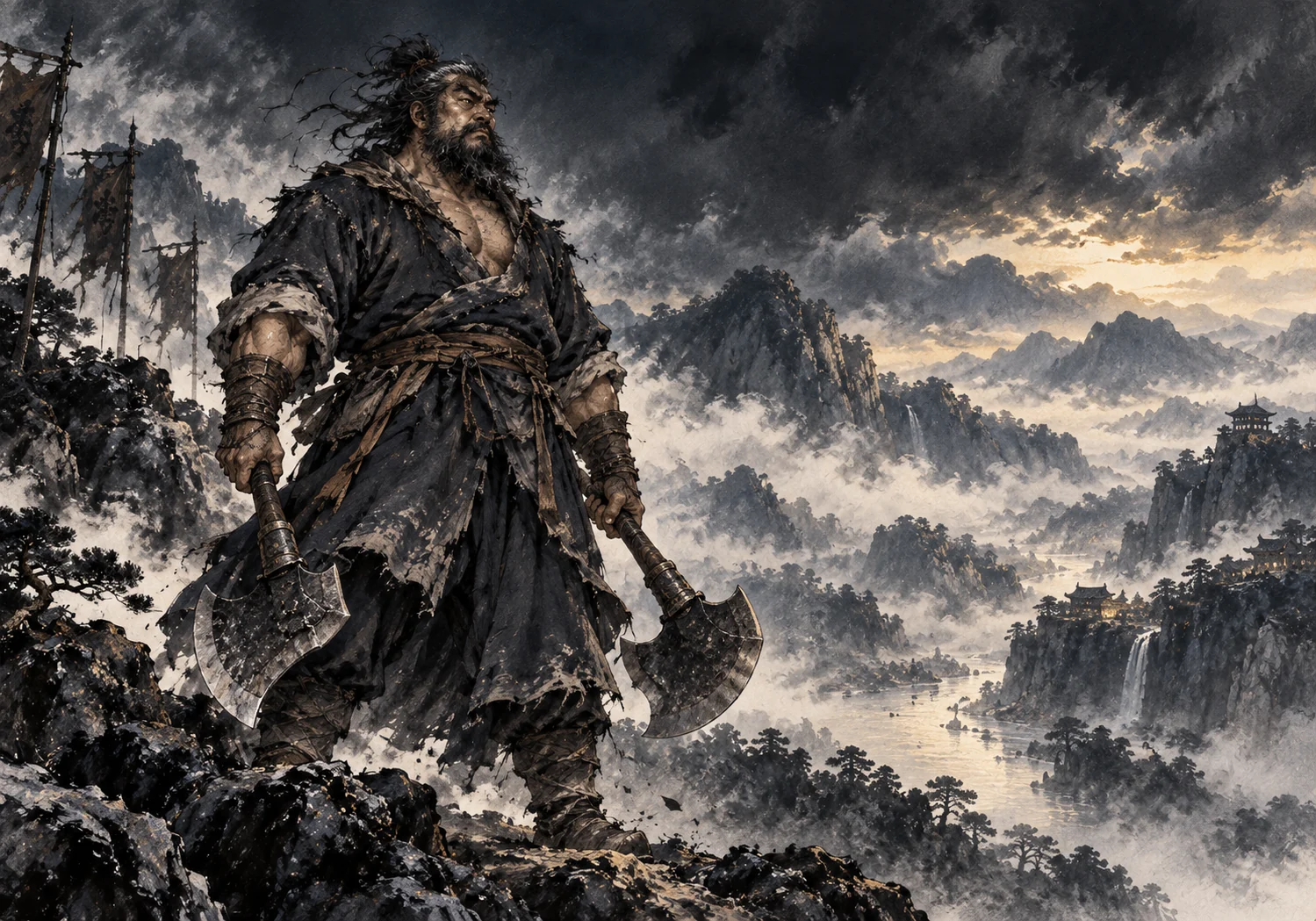
Li Gun李衮
Sky-Soaring Great Sage
The shield turns back. The crossing offers no cover.
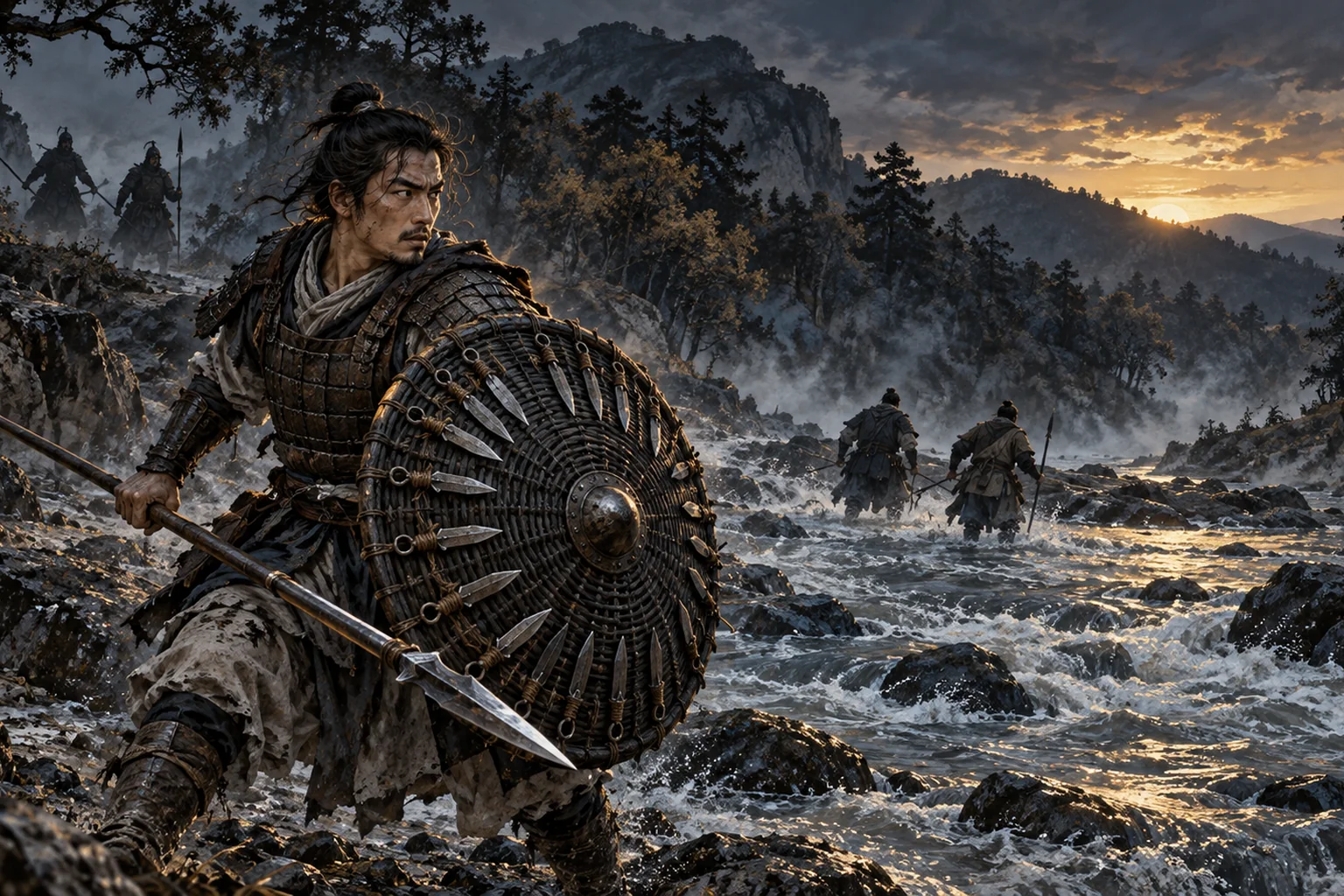
Li Gun fights with a sword behind a beast-headed shield, twenty-four javelins ready at his back. Near Muzhou, the same compact method meets a battlefield split by water.
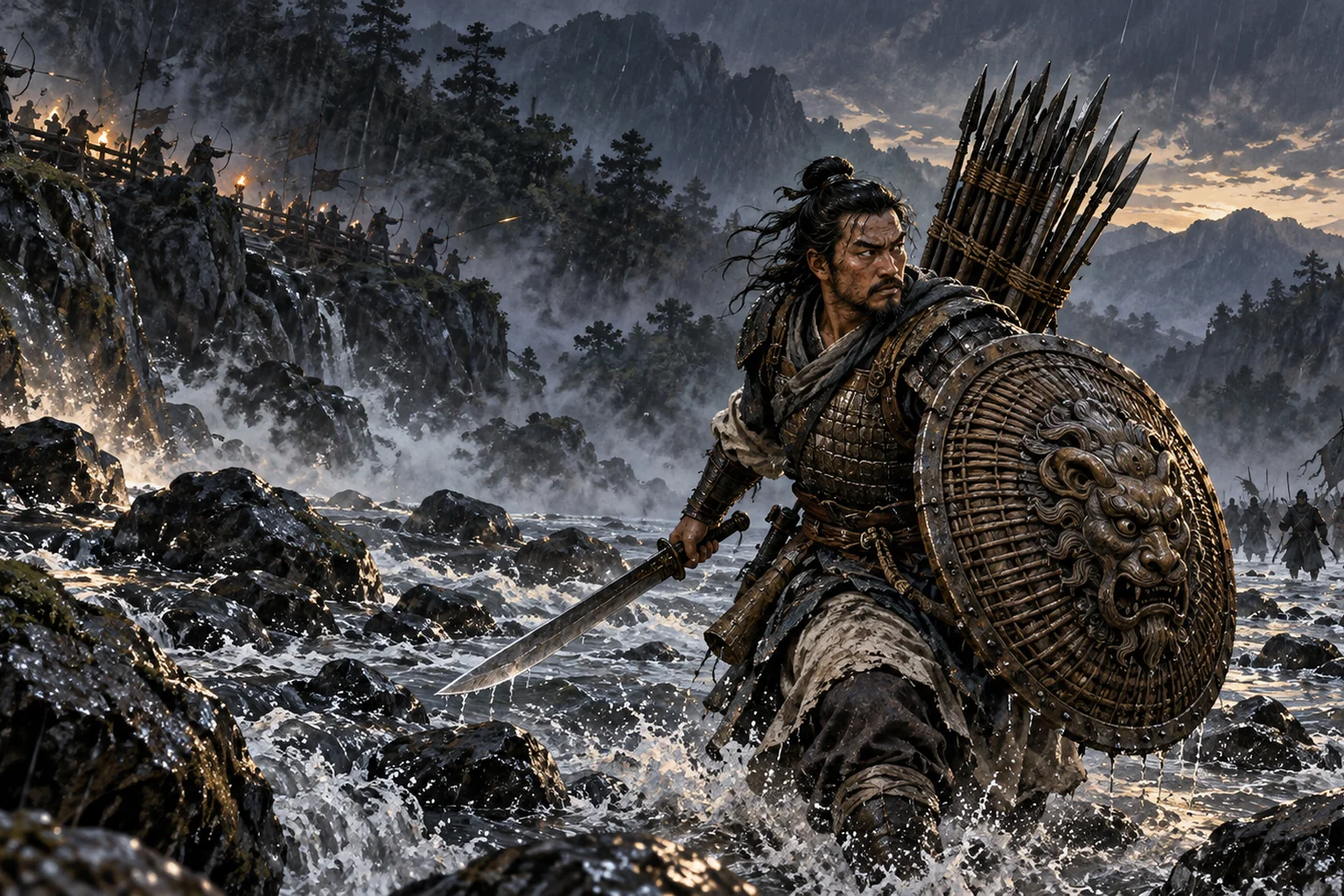
A sword behind the beast-headed shield
Li Gun is one of the three chiefs at Mangdang Mountain. Fan Rui commands roughly three thousand followers, while Li Gun and Xiang Chong lead beside him. Their group plans to challenge Liangshan rather than seek a place within it.
Li Gun carries a sharp sword and a shield marked with a beast’s head. He also keeps twenty-four short javelins ready to throw and is described as accurate at a hundred paces. His name, Sky-Soaring Great Sage, recalls the Monkey King’s title; the novel presents the reference as a martial nickname, not a supernatural power.
When Shi Jin brings the first Liangshan force against the mountain, Li Gun and Xiang Chong raise their shields and drive into the ranks. Their close advance and thrown weapons break the rear of the formation. The victory depends on the pair moving together with men behind them.
The route disappears inside the formation
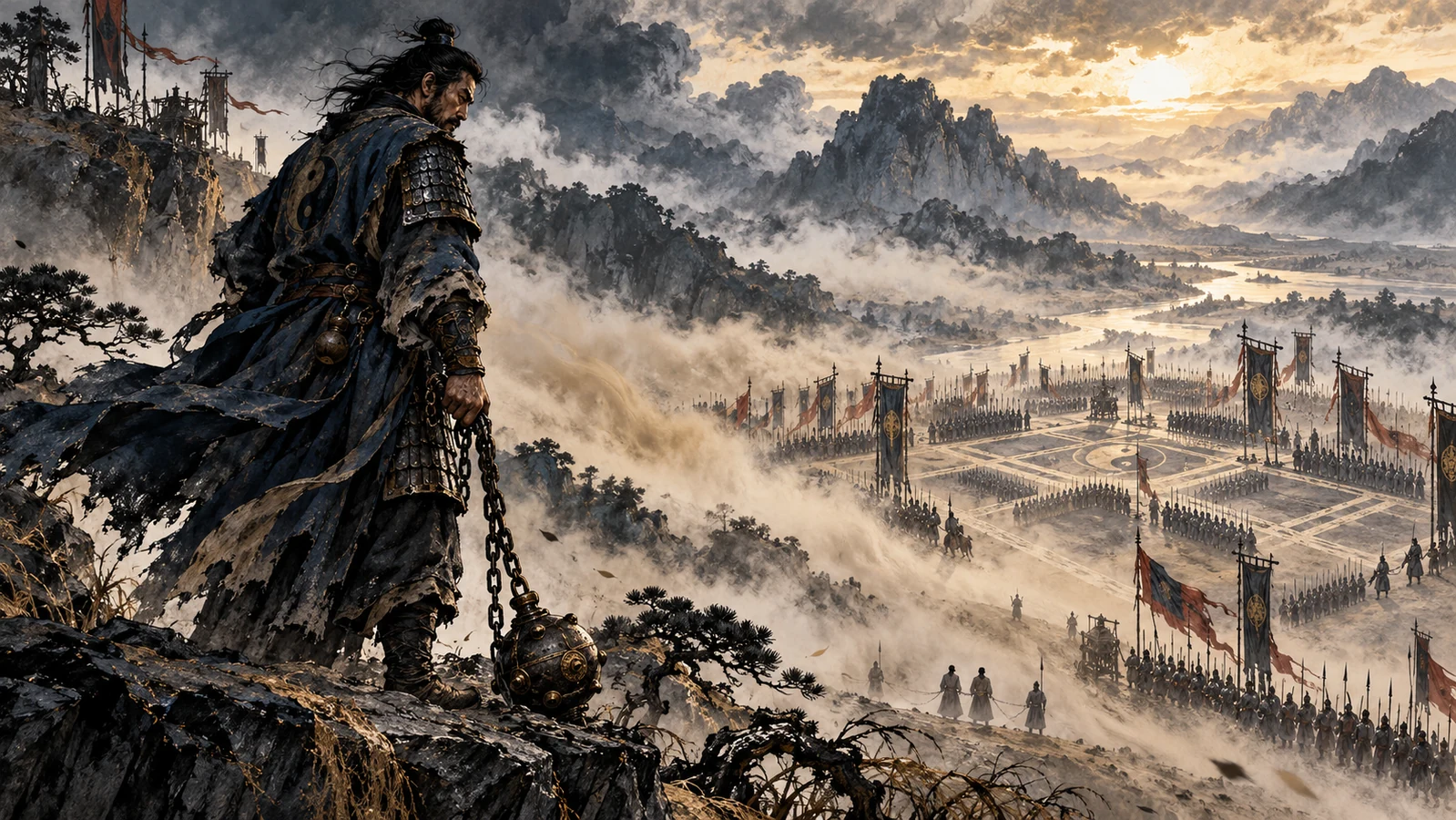
Liangshan returns after Gongsun Sheng prepares a formation. Fan Rui raises wind and sand, and Li Gun and Xiang Chong lead five hundred swordsmen toward an opening. Arrows and bolts stop most of the force; only about fifty enter with the two chiefs.
The formation closes and changes around them. Each attempted escape meets another line of soldiers. Unable to recover a route, Li Gun and Xiang Chong step onto prepared ground, fall into a pit and are pulled out with hooks.
Song Jiang orders both men untied and returns food, clothes, horses and weapons. He releases them together, keeping neither as a hostage. Li Gun and Xiang Chong carry the invitation back to Fan Rui; the three burn their stronghold and join Liangshan.
A paired method cannot stay paired forever
Li Gun is almost always described beside Xiang Chong. Their weapons differ—the sword and short javelins answer the iron javelin and flying knives—but their method is shared: shields forward, missiles at range and a line advancing behind them.
At the assembly, Li Gun ranks sixty-fifth as the Earthly Walking Star and serves among the infantry commanders. Later campaigns repeatedly place both shield-bearers beside Li Kui, Fan Rui and Bao Xu. The partnership makes two individual fighters into moving cover for a larger rush.
Near Muzhou, Li Gun and Xiang Chong again follow Li Kui across a stream while pursuing Zheng Biao. Enemy troops cut the three off from the main force. Xiang Chong is killed when he turns back; Li Gun is struck by arrows at the crossing and falls into the water. The two men who entered battle as a pair die in the same broken advance, once the stream separates them from the formation behind.
What remains of a shared method when the people who carry it can no longer stay together?
What part of Li Gun’s story stays with you?
Reading Li Gun.
Who is Li Gun in Water Margin?
Li Gun is a shield-bearing bandit chief at Mangdang Mountain and Liangshan infantry commander, known as Sky-Soaring Great Sage. The novel places this character 65 in the assembly of the 108 heroes. That rank is not a judgment of moral worth.
Why is Li Gun called the Sky-Soaring Great Sage?
The nickname recalls the Great Sage title associated with the Monkey King. In Water Margin, Li Gun is a human fighter using a sword, a beast-headed shield and twenty-four short javelins; the name does not give him supernatural powers.
Published · Updated
Written by Liangshan Lore, based on Water Margin (Shuihu Zhuan), traditionally attributed to Shi Nai’an. The novel follows an outlaw brotherhood in a fictionalized Song-dynasty setting. It is literature, not a record of each character’s historical life.
Chapter references below follow the 120-chapter Chinese edition. Other editions and English translations differ in chapter numbering, names, and endings. These are original English summaries, not quotations from a modern translation. The reflection above is our interpretation. Artwork is a concept illustration.
Continue in English.
These credited resources offer further reading, listening, publication context, or museum evidence. Chinese Lore is an English retelling with transcripts and audio, not a line-by-line translation; podcast episode numbers differ from novel chapters.
Chinese original · text & chapter references
Primary-text references for checking the plot and edition. These pages are in Chinese.