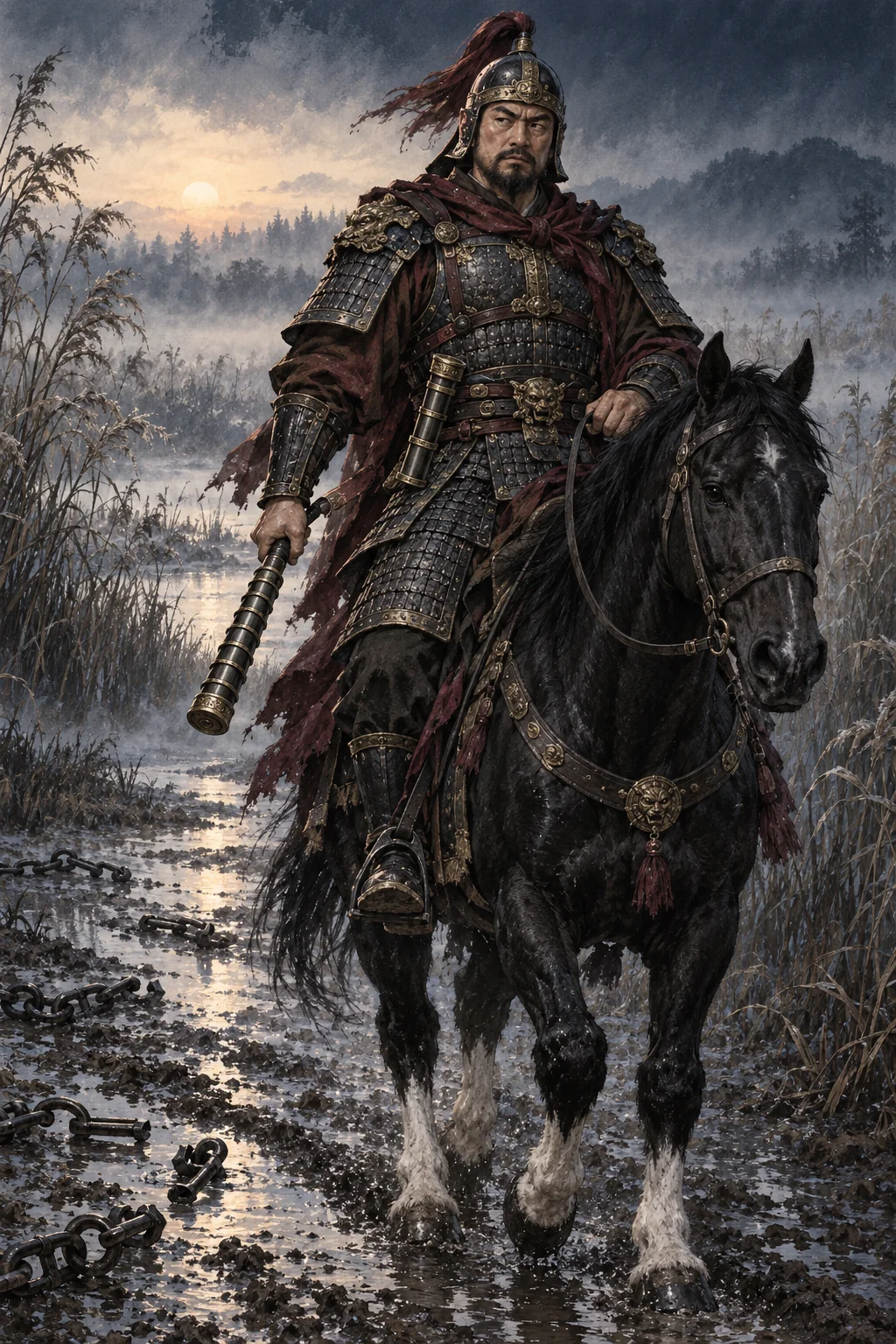
Guan Sheng关胜
Great Blade
The lantern is there. The guide is gone.
Guan Sheng rides toward a red lantern with five hundred horsemen behind him. At the camp, they find no one. When he calls for Huyan Zhuo, the man who led them here has disappeared.
Who is Guan Sheng in Water Margin?
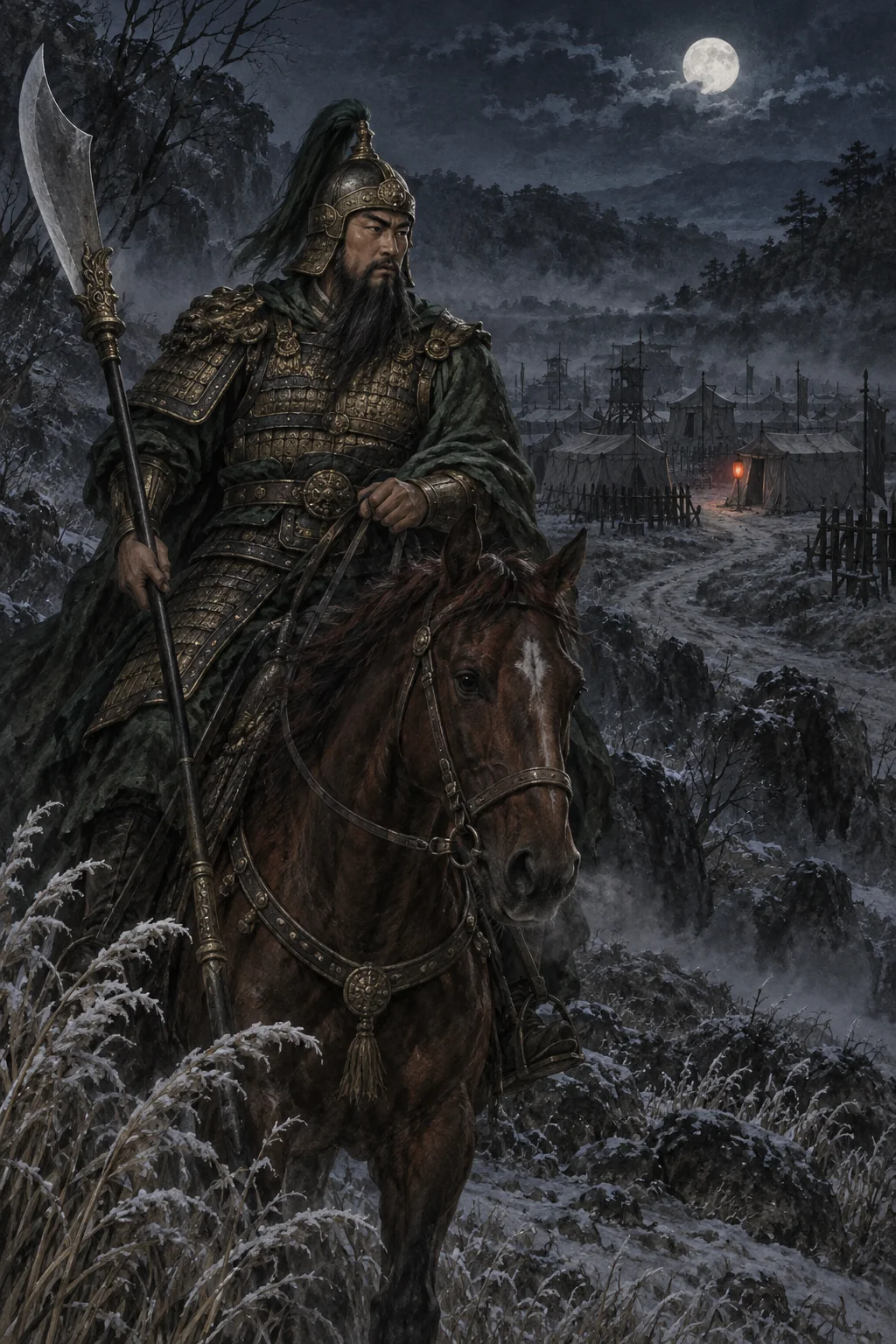
Guan Sheng, known as Great Blade, is an officer sent by the imperial court against Liangshan. Huyan Zhuo’s false defection draws him into a night ambush; after his capture, the commander changes allegiance and joins the outlaws.
An officer who knows how to set a trap
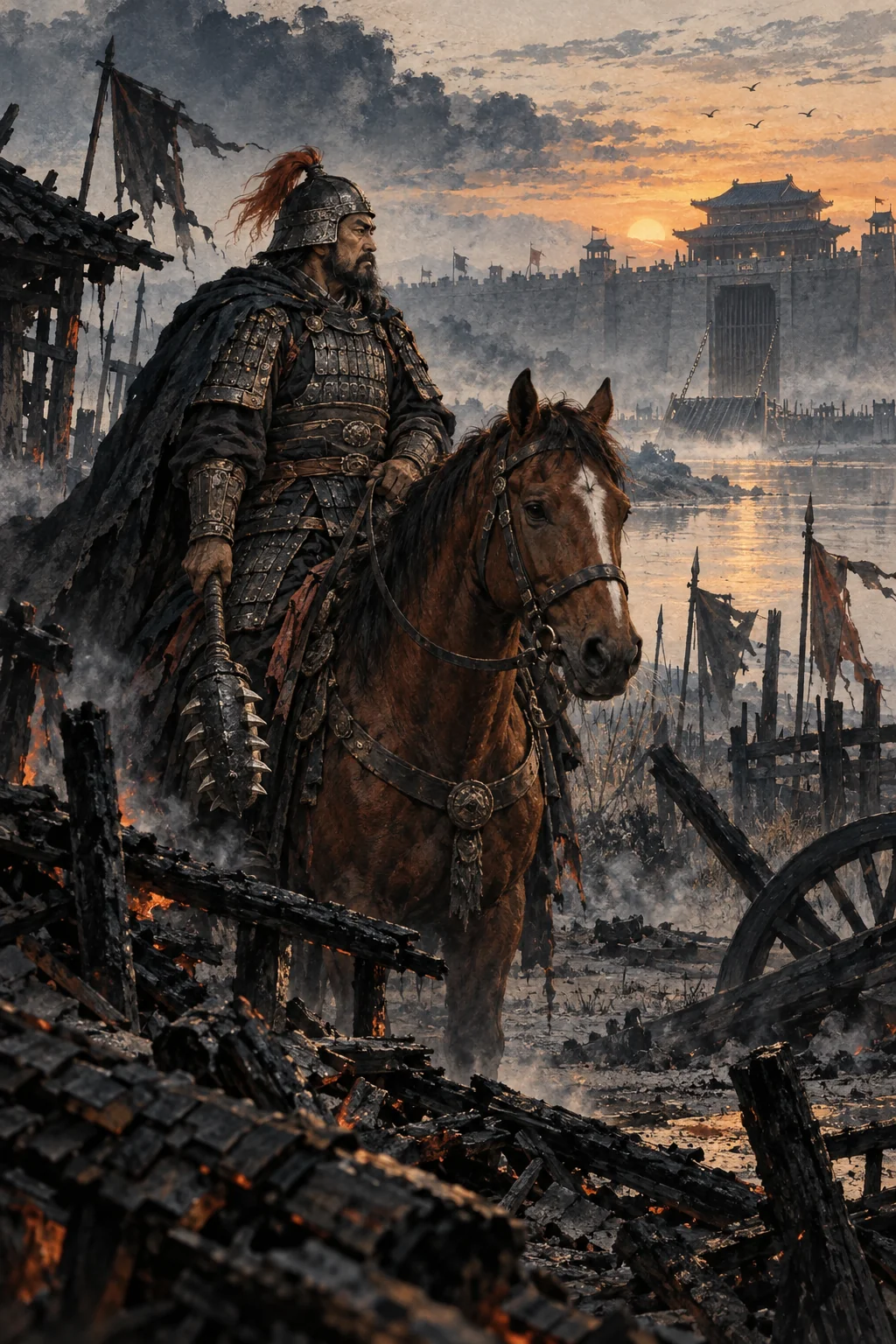
Guan Sheng’s promotion begins with a city under siege. Song Jiang’s outlaws surround Daming, where Lu Junyi and Shi Xiu are imprisoned. At court, Xuan Zan recommends a patrol officer from Pudong. The novel gives Guan Sheng a famous ancestry: he is a descendant of Guan Yu, the warrior associated with the Three Kingdoms. His long beard and Green Dragon crescent blade echo that older figure. This is the novel’s family connection, not a documented genealogy.
Asked how to relieve Daming, Guan Sheng proposes attacking the outlaws’ home instead. The court gives him fifteen thousand troops, with Hao Siwen and Xuan Zan beside him. The plan works. News of the army approaching the stronghold at Liangshan Marsh draws Song Jiang away from the city and back toward the marsh.
When Zhang Heng brings a raiding force ashore, Guan Sheng’s sentries spot it. He keeps reading in his illuminated tent while his men wait out of sight. Zhang Heng rushes in and is captured. A second raid follows, this time to rescue him. It reaches an apparently deserted camp. Another ambush closes, and Ruan Xiaoqi is taken too.
In open battle, Guan Sheng meets Qin Ming and Lin Chong together. Before they can defeat him, Song Jiang recalls them, hoping to bring the imperial general into the brotherhood. Guan Sheng returns to camp with his army still in the field and the two prisoners still in his hands.
A visitor with the right credentials
That night, a bearded officer comes to his tent without armor or weapons. It is Huyan Zhuo, who once commanded an imperial force against Liangshan and now serves among the outlaws. He claims to want his old allegiance back. According to his account, Song Jiang also wants to surrender, but the other chieftains stand in the way.
Huyan Zhuo offers to lead Guan Sheng along a back road into their camp the following night. The proposal turns the day’s unexplained withdrawal into something that seems useful: Song Jiang’s restraint can be read as a step toward submission. Guan Sheng accepts the visitor’s account and entertains him with wine.
The next day Huyan Zhuo appears to fight on Guan Sheng’s side. He knocks Huang Xin from his horse in front of both armies. That evening, Guan Sheng orders Hao Siwen and Xuan Zan to provide support and takes five hundred riders on the secret route. The horses’ bells are removed for the approach. Huyan Zhuo rides ahead.
Beyond a bend in the hills, the guide points toward a red lantern. Guan Sheng advances. A cannon signal sounds, and his horsemen charge toward the light. There is no enemy commander waiting beneath it. There is no guide left to explain the absence.
Drums and gongs sound from the hills around them. The riders scatter. Guan Sheng turns back with only a few men, but another signal sounds near the trees. Hooks drag him from his saddle. His captors take his blade and horse, strip off his armor, and bring him to Liangshan.
At the hall, Song Jiang unties him, offers him the central chair, and bows. Huyan Zhuo apologizes for the deception. With Hao Siwen and Xuan Zan captured as well, Guan Sheng says they cannot face a return to the capital. Song Jiang offers to send him back if he will not stay. Guan Sheng joins instead, and his household is brought from Pudong.
Soon he volunteers to lead the advance against Daming, the city his commission had been meant to protect. By the assembly in chapter 71, he holds fifth place among the 108 and commands among Liangshan’s Five Tiger Generals of cavalry.
The trap he could not read from a distance
Guan Sheng can recognize an exposed landing and arrange men around an empty camp. His defeat comes through a different opening. Huyan Zhuo brings a familiar professional history and an account in which victory requires cooperation rather than another difficult battle.
The false defection makes trust itself part of the terrain. We can understand why the offer is persuasive without treating that persuasion as proof. The red lantern gives the plan a visible destination; it supplies no evidence that the story behind the plan is true.
The welcome afterward has a cost behind it. An army has broken, his companions have been captured, and the officer who came to defend a city is now preparing to attack it. His new place among the commanders does not erase the people carried across that change of allegiance.
What makes a familiar voice enough to lower your guard?
What part of Guan Sheng’s story stays with you?
Reading Guan Sheng.
Is Guan Sheng the same person as Guan Yu?
No. Water Margin presents Guan Sheng as a descendant of Guan Yu, the earlier Three Kingdoms warrior. Guan Sheng is a separate fictional character in a Song-dynasty setting; the novel’s ancestry claim is not proof of a historical family line.
What weapon does Guan Sheng carry, and where does he rank?
He carries a Green Dragon crescent blade on a long shaft, often called a guandao in English. Chapter 71 places him fifth among the 108 and among the Five Tiger Generals of Liangshan’s cavalry. This is the novel’s roster and military organization, not a ranking of virtue.
Published · Updated
Written by Liangshan Lore, based on Water Margin (Shuihu Zhuan), traditionally attributed to Shi Nai’an. The novel follows an outlaw brotherhood in a fictionalized Song-dynasty setting. It is literature, not a record of each character’s historical life.
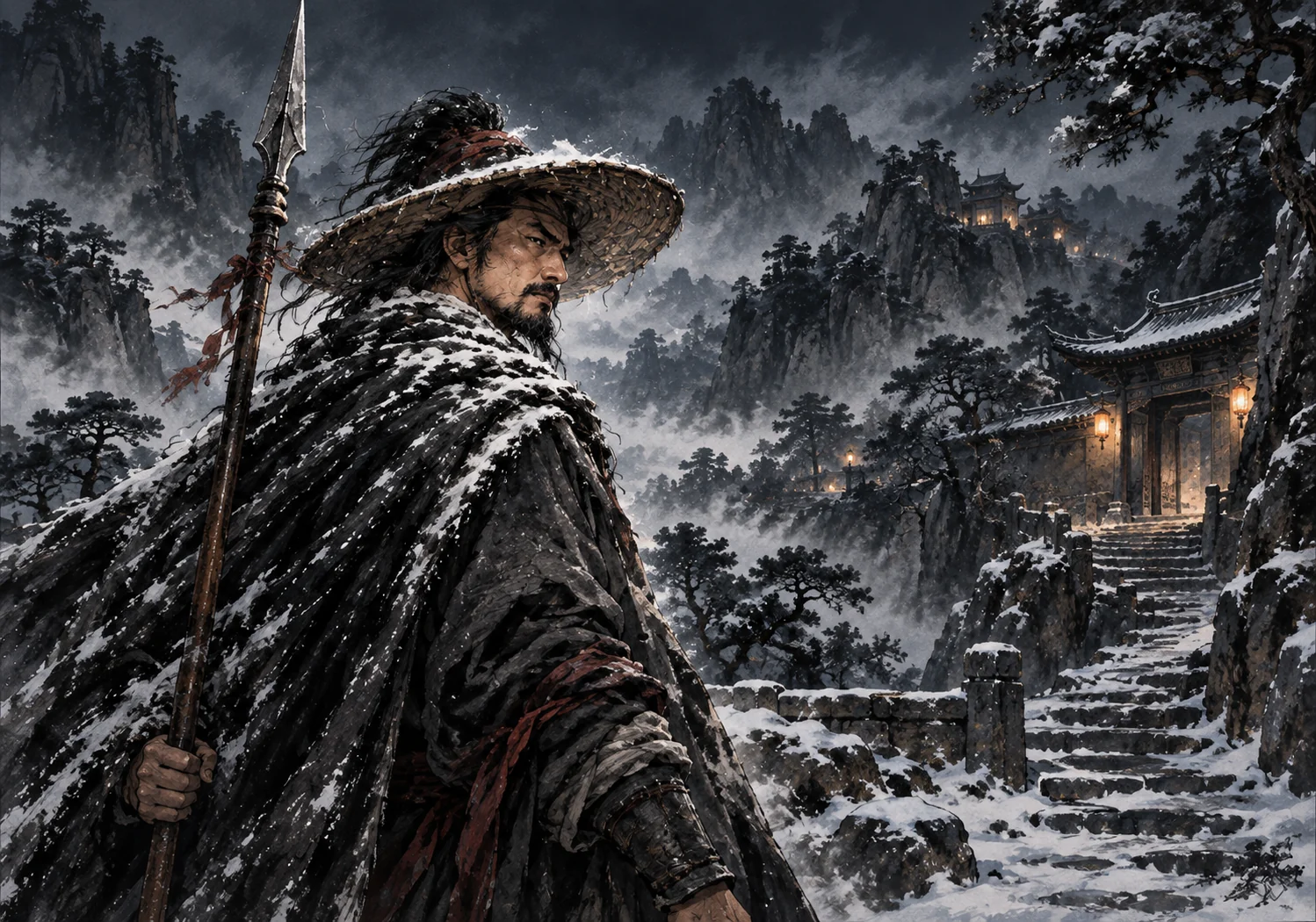
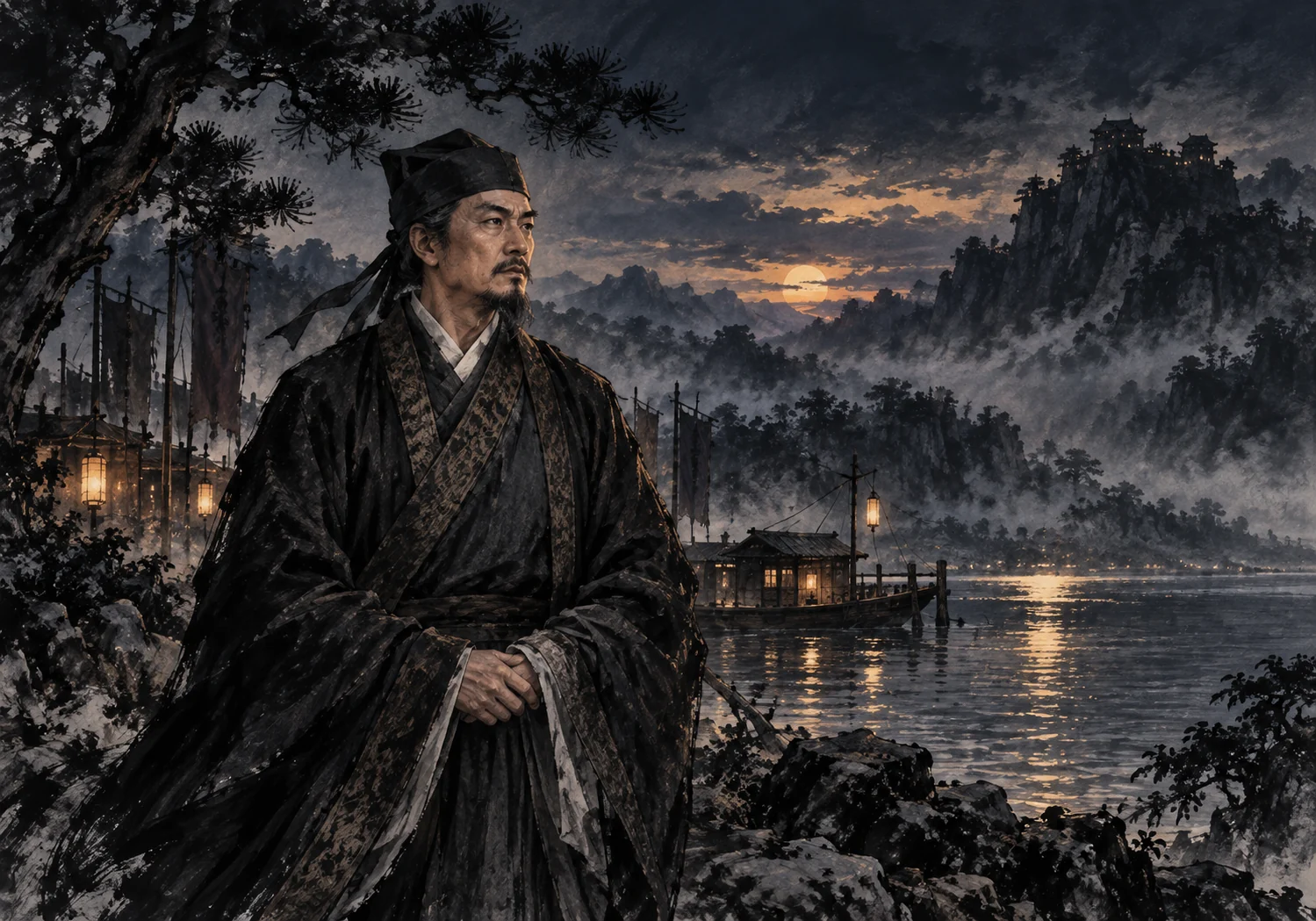
Chapter references below follow the 120-chapter Chinese edition. Other editions and English translations differ in chapter numbering, names, and endings. These are original English summaries, not quotations from a modern translation. The reflection above is our interpretation. Artwork is a concept illustration.
Continue in English.
These credited resources offer further reading, listening, publication context, or museum evidence. Chinese Lore is an English retelling with transcripts and audio, not a line-by-line translation; podcast episode numbers differ from novel chapters.
Chinese original · text & chapter references
Primary-text references for checking the plot and edition. These pages are in Chinese.