Huyan Zhuo呼延灼
Double Whips
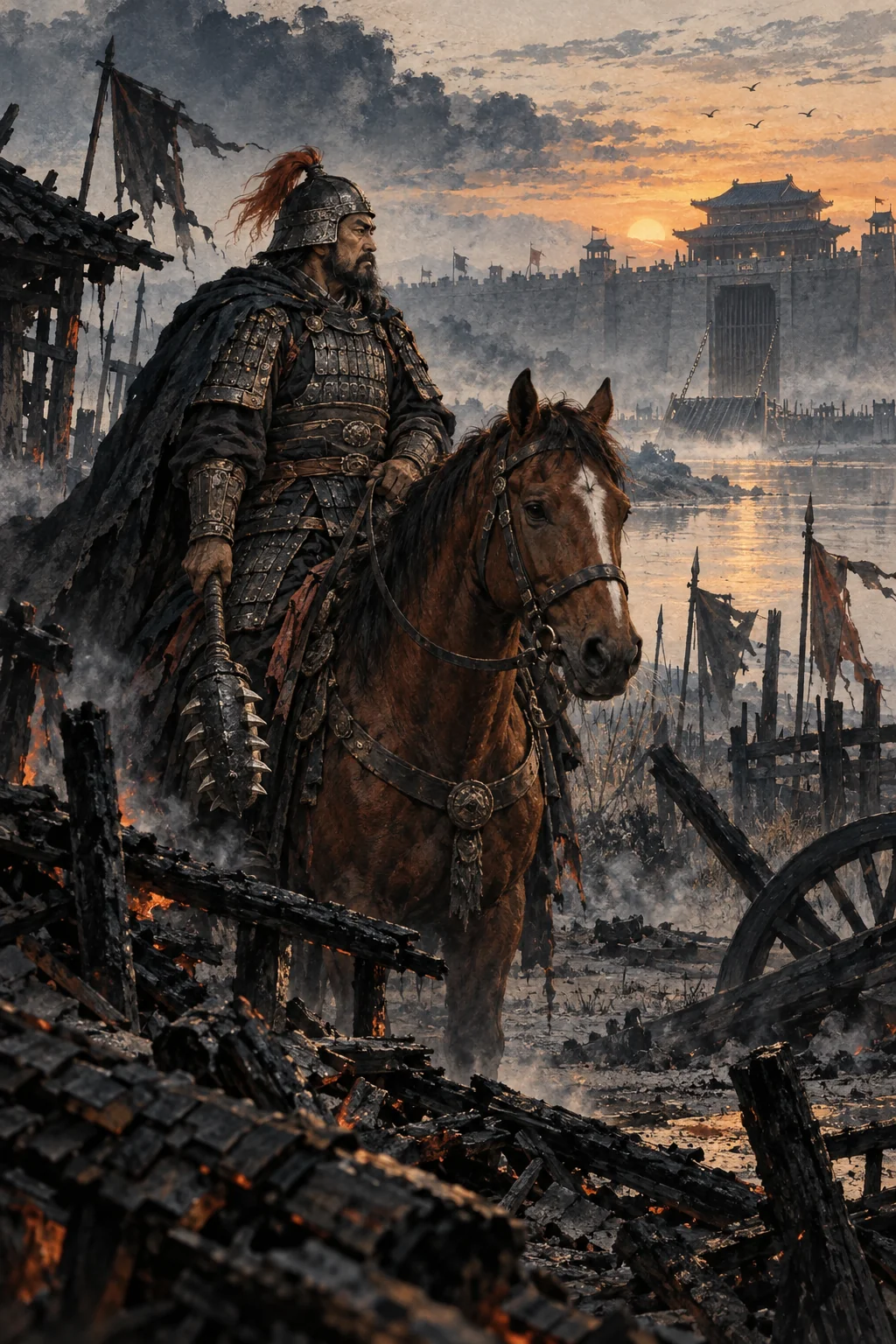
He rides out of the marsh alone.
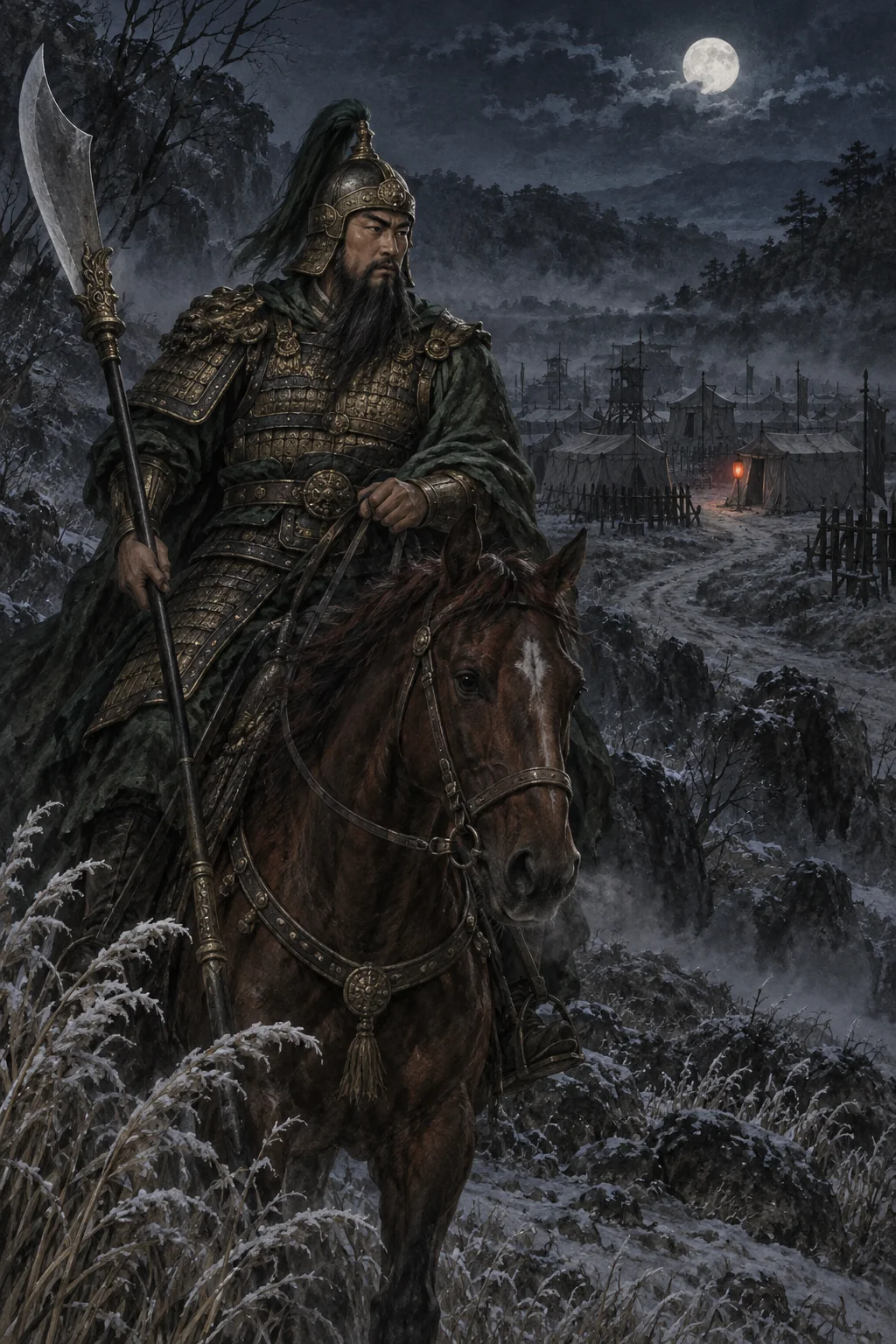
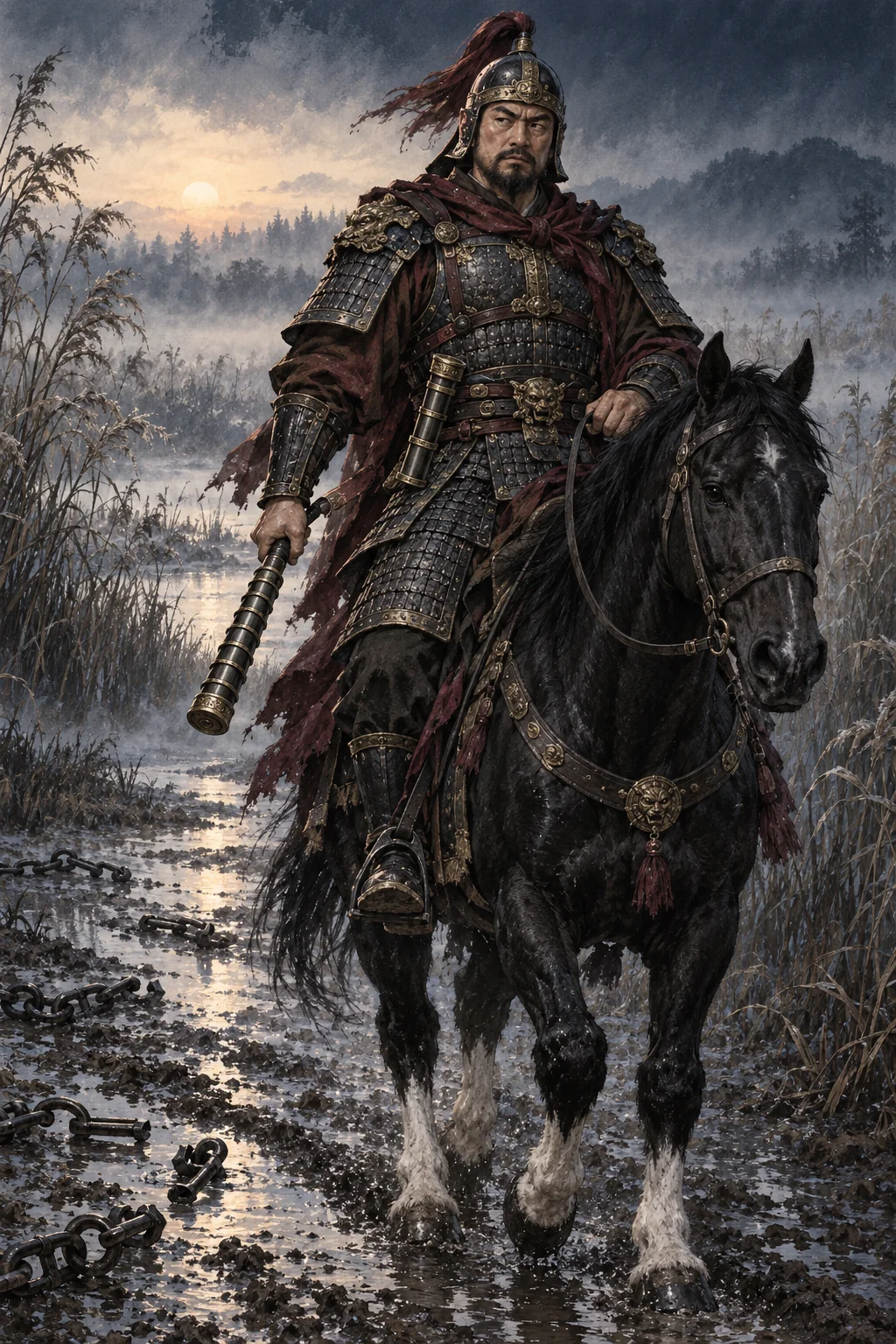
Huyan Zhuo escapes on the black horse the emperor gave him. Behind him, his armored cavalry has broken in the reeds. On the road toward Qingzhou, he sells his gold belt to pay for food.
Who is Huyan Zhuo in Water Margin?
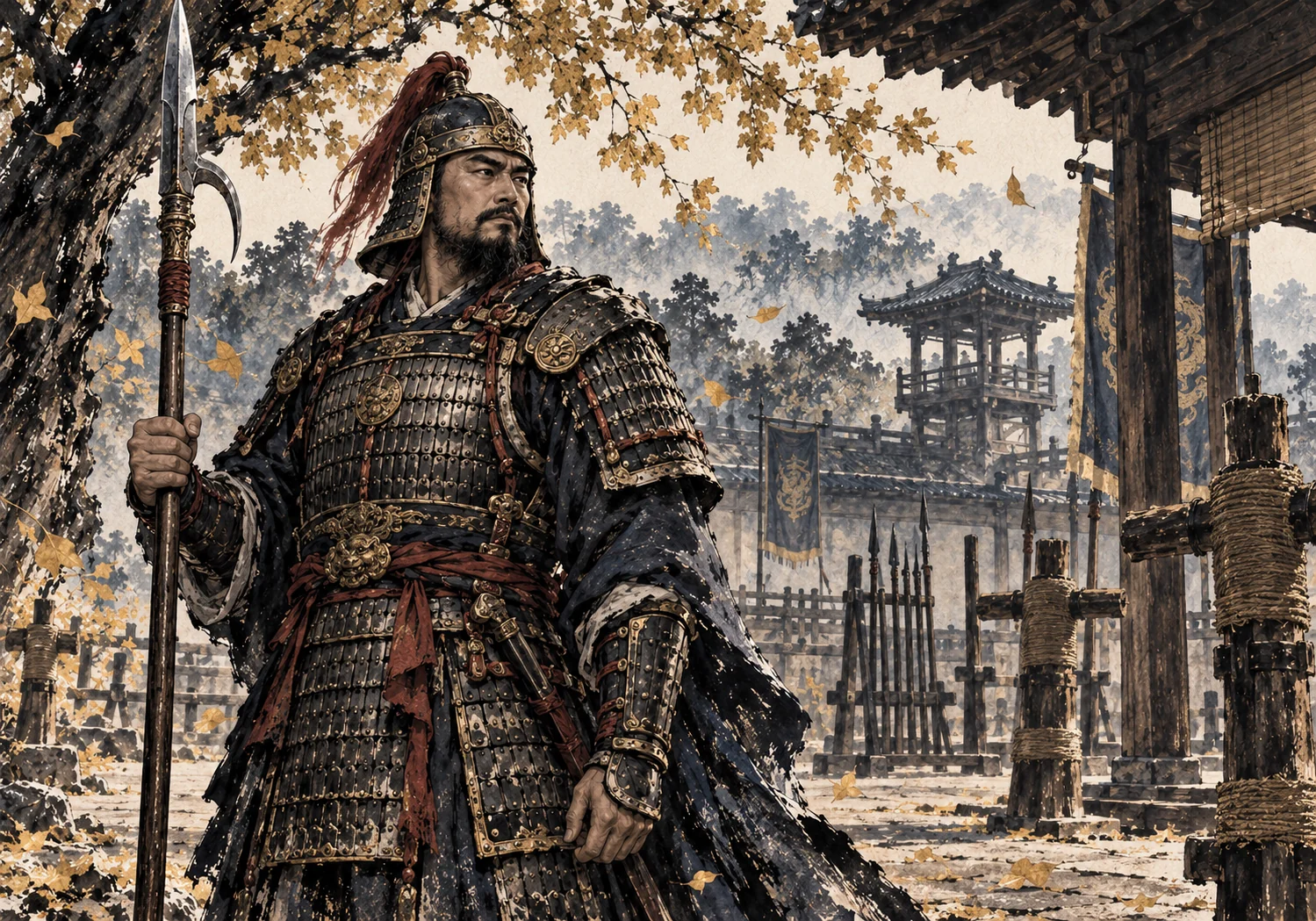
Huyan Zhuo is the imperial cavalry commander called Double Whips. Xu Ning’s hooked lances defeat his linked cavalry, and the subsequent Qingzhou conflict brings the displaced commander into Liangshan.
The emperor’s horse and an army in chains
Before this solitary journey, Huyan Zhuo receives a commission against the stronghold at Liangshan Marsh. Gao Qiu recommends him to the court; the emperor rewards him with a black horse whose four feet are white. The novel presents him as a descendant of the early Song general Huyan Zan. That ancestry belongs to the fiction, rather than an established family history.
His nickname is Double Whips, or Shuangbian (双鞭). These are rigid metal striking weapons, not the flexible leather lashes the English name may suggest. Han Tao and Peng Qi join his command. Three thousand armored horsemen and five thousand infantry march toward the marsh.
The cavalry’s horses are connected by iron chains. The formation advances as a mass, leaving little room for an opponent to break through. It wins a major encounter: Liangshan’s fighters retreat toward their boats, Lin Chong is wounded, and hundreds of men are captured. Huyan Zhuo has good reason to keep using what has worked.
What happens when one horse falls
Liangshan answers by obtaining a particular skill. Xu Ning teaches the hooked lance, but he does not arrive as a willing recruit: stolen armor draws him away from the capital, and further deception closes his way home. The method that will defeat Huyan Zhuo comes with its own human cost.
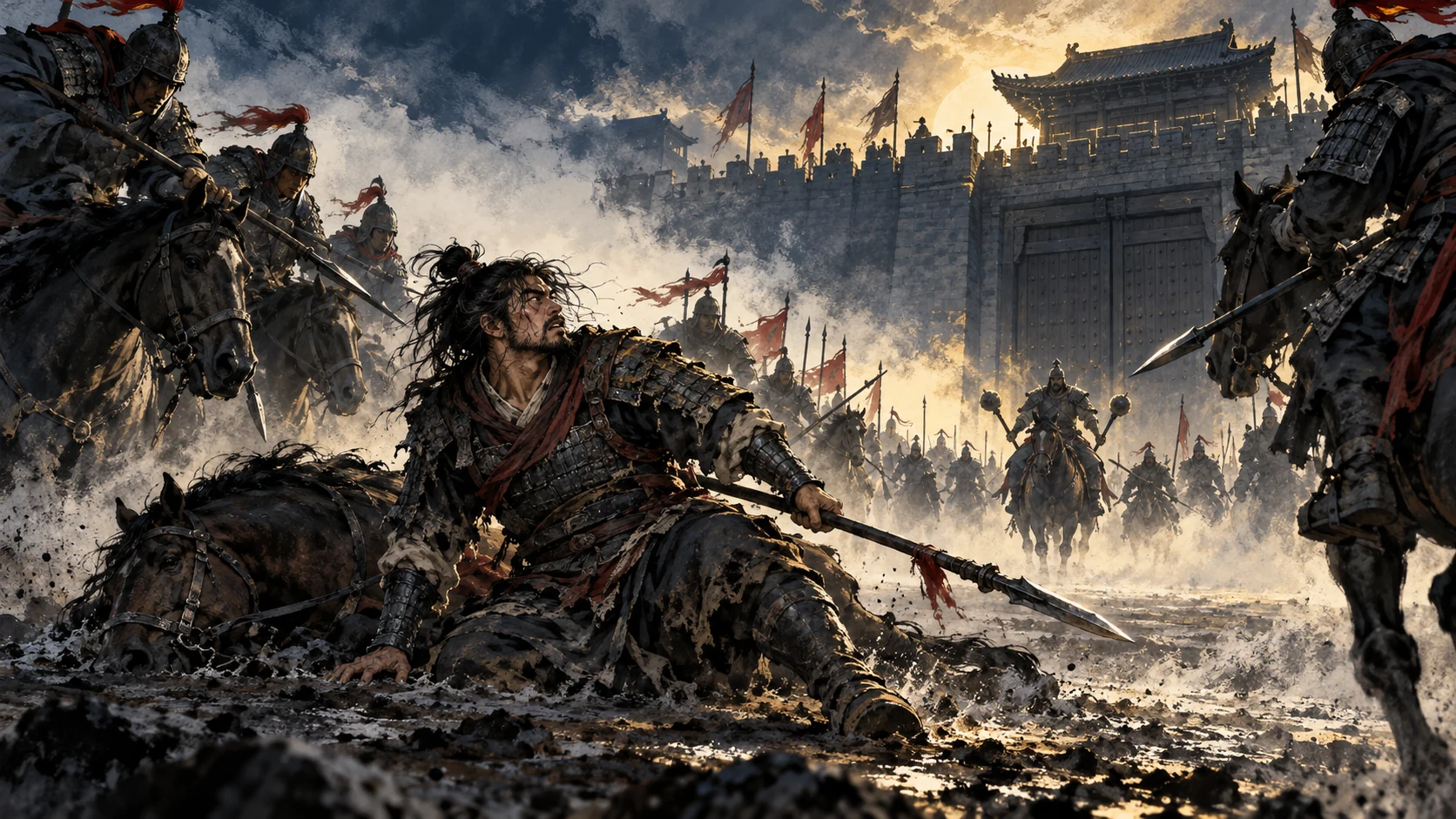
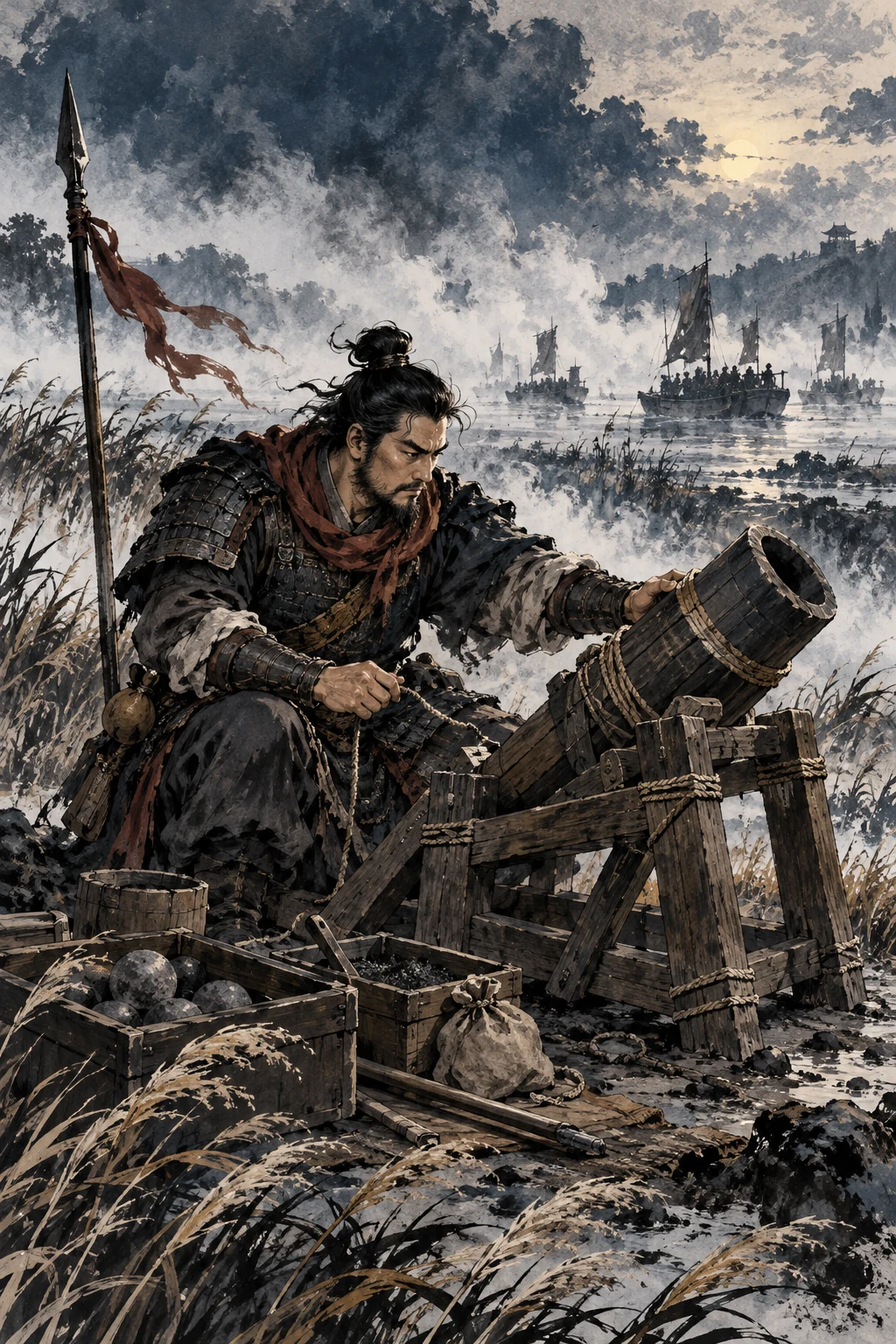
At dawn, Liangshan’s infantry draws the cavalry toward the reeds. Men concealed in the grass attack the horses’ legs with hooked lances and pull riders down. A fallen horse obstructs the animals chained beside it. The connection that made the advance formidable now helps the confusion spread. Horses are maimed and men taken prisoner. The army does not simply retreat intact.
Huyan Zhuo gets clear on the imperial horse. Without his command, he cannot make an ordinary return to court. He sells his belt for food and reaches an inn. During the night, bandits steal the horse. He follows their torches along the road but fails to catch them.
A second chance comes from Qingzhou’s Prefect Murong. He provides another horse and two thousand soldiers, offering help in restoring Huyan Zhuo’s position if he defeats the nearby mountain bands. Huyan Zhuo fights Lu Zhishen and Yang Zhi without a decisive result. The wider conflict brings Song Jiang’s force to Qingzhou.
A familiar voice opens the city gate
Before dawn, Huyan Zhuo pursues Song Jiang and his companions outside the city. Near a dead tree, horse and rider fall into a concealed pit. This time there is no road out. He is bound and brought before the outlaw leader.
Song Jiang unties him, offers him a seat and speaks of eventual imperial amnesty. Huyan Zhuo first proposes seeking a pardon from the court. Song Jiang points instead to the lost army and Gao Qiu’s likely response. The captured commander accepts a place among the outlaws. His stolen horse is returned by the mountain band that took it.
That evening he rides to Qingzhou with outlaw leaders disguised as government troops. The guards recognize his voice. Prefect Murong opens the gate to the officer he has just equipped. Qin Ming kills the prefect; the outlaws also execute the prefect’s family, including children. Orders to spare other residents do not make this a bloodless rescue. Huyan Zhuo’s help gets the attackers inside.
Later, he uses his former imperial service to persuade Guan Sheng to follow him into another trap. At the assembly in chapter 71, Huyan Zhuo holds eighth place among the 108 and serves among Liangshan’s Five Tiger Generals of cavalry.
The people carried through a second chance
Our interpretation begins with the belt sold for a meal. The commander still has his weapons and his skill, but the institution that supplied his army is no longer a place he can easily return to. Murong’s borrowed horse gives his career somewhere to go again.
The city gate makes that dependence difficult to turn into a reassuring lesson. Murong trusts an officer he has helped; Song Jiang gains an officer whose voice can get him admitted. Huyan Zhuo survives the change, while people inside Qingzhou bear its consequences.
His new rank records a place in the brotherhood. It cannot settle what that place has cost. Reading him beside Xu Ning and Qin Ming leaves several kinds of recruitment in view: skills taken through deception, a refusal made impossible, and a defeated man offered a way forward.
Who bears the cost when we find a way forward?
What part of Huyan Zhuo’s story stays with you?
Reading Huyan Zhuo.
How does Xu Ning defeat Huyan Zhuo’s linked cavalry?
Xu Ning trains Liangshan’s men to use hooked lances. In chapter 57 of the 120-chapter text, fighters hidden in reeds attack the horses and drag riders down. The iron links make fallen horses obstruct others. This is a battle in the novel, not a verified account of historical cavalry tactics.
What are Huyan Zhuo’s double whips?
His bian are rigid metal striking weapons. Double Whips translates Shuangbian (双鞭); it should not be read as a pair of flexible leather whips. The character belongs to Liangshan’s Five Tiger Generals of cavalry.
Published · Updated
Written by Liangshan Lore, based on Water Margin (Shuihu Zhuan), traditionally attributed to Shi Nai’an. The novel follows an outlaw brotherhood in a fictionalized Song-dynasty setting. It is literature, not a record of each character’s historical life.
Chapter references below follow the 120-chapter Chinese edition. Other editions and English translations differ in chapter numbering, names, and endings. These are original English summaries, not quotations from a modern translation. The reflection above is our interpretation. Artwork is a concept illustration.
Continue in English.
These credited resources offer further reading, listening, publication context, or museum evidence. Chinese Lore is an English retelling with transcripts and audio, not a line-by-line translation; podcast episode numbers differ from novel chapters.
Chinese original · text & chapter references
Primary-text references for checking the plot and edition. These pages are in Chinese.