Why Did Lin Chong Become an Outlaw?
He is driven to Liangshan through a series of closed exits: staying quiet, accepting exile, doing his assigned work. None keeps him safe from the men who want him gone.
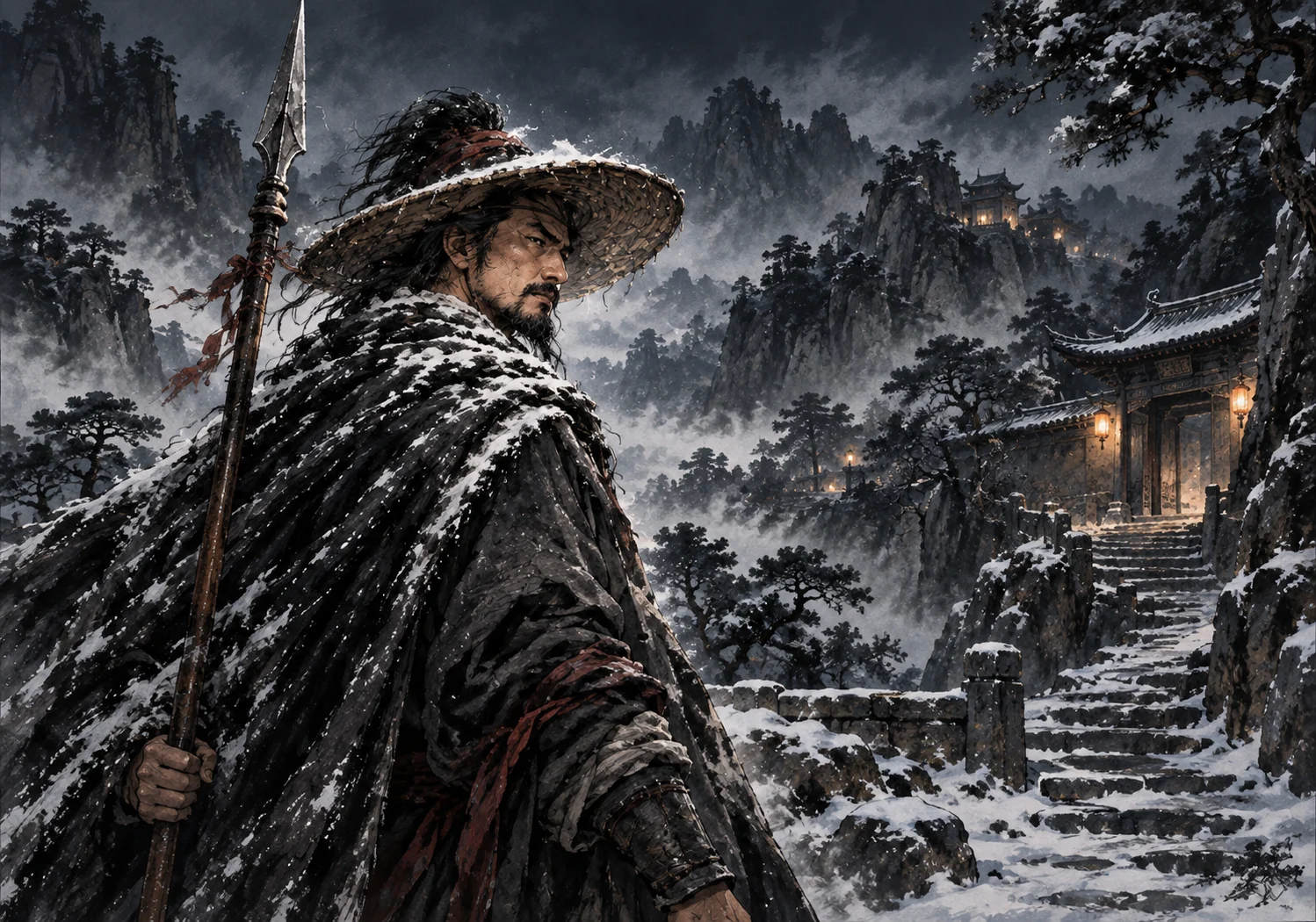
His family is threatened by his own hierarchy
Lin Chong teaches the imperial guards in the capital. When Gao Yanei harasses his wife, he is ready to confront him, then recognizes the adopted son of Gao Qiu. The threat to his family comes from someone protected by the institution he serves.
Restraint makes sense for a man with a livelihood and a household to protect. But the harassment does not stop. The imbalance of power means that even avoiding a fight cannot settle the quarrel.
A summons turns into a criminal charge
Lin Chong buys a sword and is summoned to Gao Qiu’s residence. He is led into the restricted White Tiger Hall, then accused because he has entered armed. The arrangement gives his enemies an official case against him.
The sentence sends him into exile at Cangzhou. On the journey, his escorts prepare to kill him in Wild Boar Forest. Lu Zhishen saves him. That rescue keeps him alive without ending the sentence or removing the people behind it.
This is why “he was wrongly punished” is only part of the answer. The legal punishment is being used as a route to murder. Accepting it does not buy safety.
Even exile is not far enough away
At Cangzhou, Lin Chong takes charge of a fodder depot. Heavy snow collapses his hut. He checks that the brazier’s embers are extinguished, takes his bedding, and shelters in a nearby temple. This accident places him outside the depot when it is set on fire.
The plotters come to the temple door. Lin Chong hears that they expect the fire to kill him—or, if he survives, that the loss of the supplies will get him executed. Lu Qian, a man he knew and trusted, is among them.
The conversation removes the last uncertainty. This is no longer a matter of surviving an unfortunate posting. His enemies intend to follow him until there is no life left to return to. He comes out and kills them.
Liangshan offers somewhere to go
After the temple confrontation, his assigned post is destroyed and he has killed the conspirators. He cannot go back to the capital or carry on quietly at the depot. Liangshan is a refuge outside the official world that has pursued him.
It is not an immediate happy ending. Wang Lun, the stronghold’s leader, fears capable newcomers and puts obstacles in his way. Lin Chong reaches a place run by people with their own interests, not a society free of the flaws he has escaped.
The Chinese idea of being “driven to Liangshan” fits him because his alternatives have been stripped away. His story is a forced departure from an ordinary life, rather than a sudden attraction to rebellion.
What the snow-night detail changes
He checks his brazier before leaving the ruined hut. That small act shows a man still taking responsibility for his work while others prepare to burn it down and blame him.
For us, it makes the break at the temple more painful. Patience has been tied to something he values: a home, a useful place, the possibility of return. Once he hears the plotters, he can no longer expect good conduct to protect those things.
His violence does not restore what he wanted. It marks the point after which he has to find another way to live.
How long can patience remain a virtue when power refuses to be fair?
Which part of the story speaks to you? Tell us as we shape the complete 108-card collection.
Original English writing by Liangshan Lore, based on the Chinese novel Water Margin, traditionally attributed to Shi Nai’an. Plot references follow the 120-chapter Chinese edition; names, chapter numbering, and endings can vary between editions and translations. Sections marked “Our reading of the story” offer our interpretation. The characters and events belong to fiction; concept illustrations are not historical portraits.
Read & listen in English.
John Zhu’s podcast offers his own English retelling, with readable transcripts and audio. Podcast episode numbers differ from the novel’s chapter numbers. The publisher pages below introduce published English translations.
Chinese original · text & chapter references
Primary-text references for checking the plot and edition. These pages are in Chinese.
Lin ChongPanther Head · illustrated character story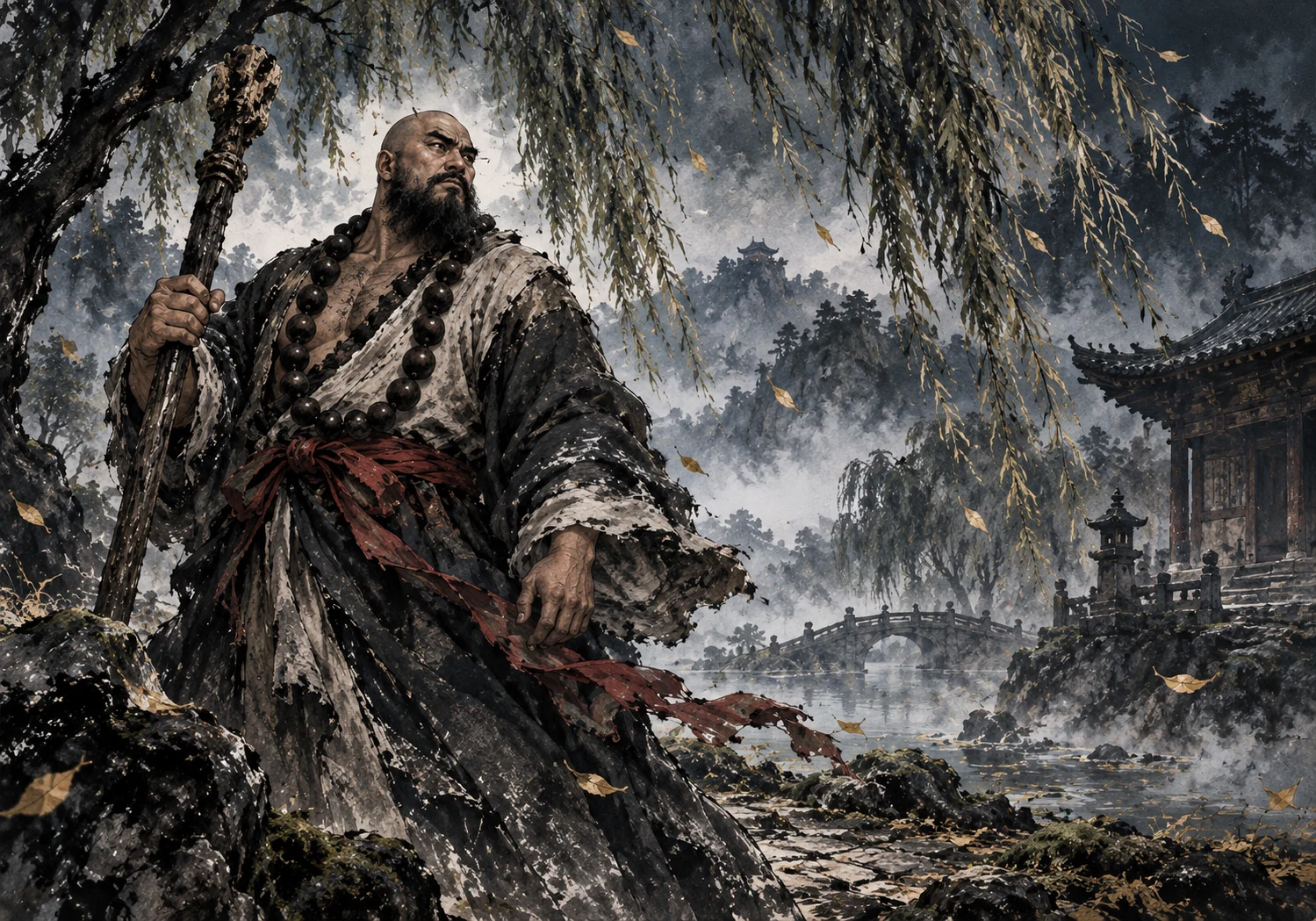 Lu ZhishenFlower Monk · illustrated character story