Was Song Jiang Real? How Water Margin Became a Novel
A rebel leader named Song Jiang appears in historical memory. The vast brotherhood around him belongs to centuries of storytelling, performance, compilation, editing, and print.
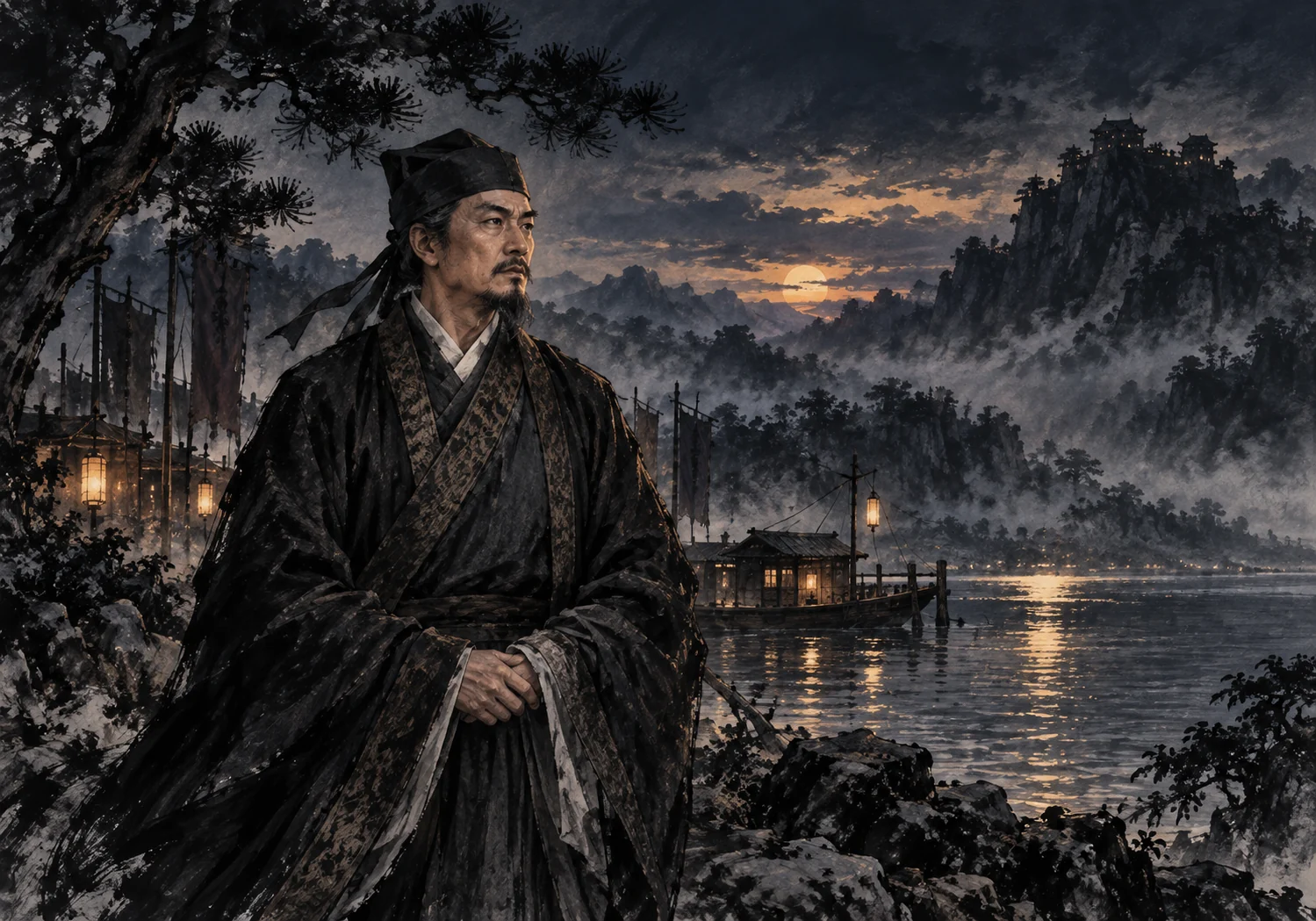
Song Jiang has a historical trace, not a complete novel-shaped biography
Sources connect a Song Jiang and followers with rebellion in the early twelfth century, near the end of the Northern Song. That trace does not verify the novel’s private scenes, 108-person roster, supernatural frame, exact friendships, or campaigns as historical fact.
Fang La also has a historical identity, but the long narrative that sends the Liangshan company against him is literary construction.
The characters circulated before one stable long text
Outlaw tales developed through oral storytelling, performance, shorter written forms, and collections of names and episodes. Audiences could recognize a figure or scene before encountering the chapter novel familiar today.
This helps explain the book’s relay structure. A character can enter with a vivid description, dominate several chapters, and later return as part of a larger company.
Traditional attribution is not a modern single-author certainty
Water Margin is traditionally attributed to Shi Nai’an, with Luo Guanzhong sometimes named in relation to its formation or editing. Surviving print history and textual variation do not support a simple picture of one author producing one final version at one moment.
The novel is commonly treated as a work of Ming vernacular fiction even though its action is set in the Northern Song.
Later editors changed what the story means
The 70-chapter edition associated with Jin Shengtan reshapes the ending around the assembly and a closing dream. The 100- and 120-chapter traditions continue through amnesty and campaigns. Commentary can also sit visibly beside the narrative and teach readers how to judge it.
There is no responsible way to discuss “the ending” or “the complete version” without naming the edition.
History gives the story a horizon, not a certificate
Historical names make corruption, rebellion, and dynastic danger feel anchored. Fiction supplies the intimate motives, patterned meetings, impossible feats, celestial order, and moral arguments through which readers know the 108.
Respecting the book means preserving both facts: a historical disturbance mattered, and the world most readers love was made by storytelling.
What does fiction make visible that a short historical record cannot—and what must it never be mistaken for?
Which part of the story speaks to you? Tell us as we shape the complete 108-card collection.
Original English writing by Liangshan Lore, based on the Chinese novel Water Margin, traditionally attributed to Shi Nai’an. Plot references follow the 120-chapter Chinese edition; names, chapter numbering, and endings can vary between editions and translations. Sections marked “Our reading of the story” offer our interpretation. The characters and events belong to fiction; concept illustrations are not historical portraits.
Continue in English.
These credited resources offer further reading, listening, publication context, or museum evidence. Chinese Lore is an English retelling with transcripts and audio, not a line-by-line translation; podcast episode numbers differ from novel chapters. CUHK Press links introduce published English translations.
Chinese original · text & chapter references
Primary-text references for checking the plot and edition. These pages are in Chinese.
Song JiangTimely Rain · illustrated character story Lu ZhishenFlower Monk · illustrated character story