Li Ying李应
Striking Hawk
The arrest is staged. The fire is not.
Li Ying asks to go home after Liangshan rescues him from arrest. Then his household arrives at the stronghold. They tell him that officials emptied the manor, loaded them onto carts, and burned the buildings behind them.
Who is Li Ying in Water Margin?
Li Ying, the Striking Hawk, controls Li Family Manor at Lone Dragon Ridge. His attempts to negotiate with the Zhu family lead to an arrow wound, while Liangshan’s staged arrest and destruction of his home remove his remaining alternatives.
Three manors and a letter of obligation
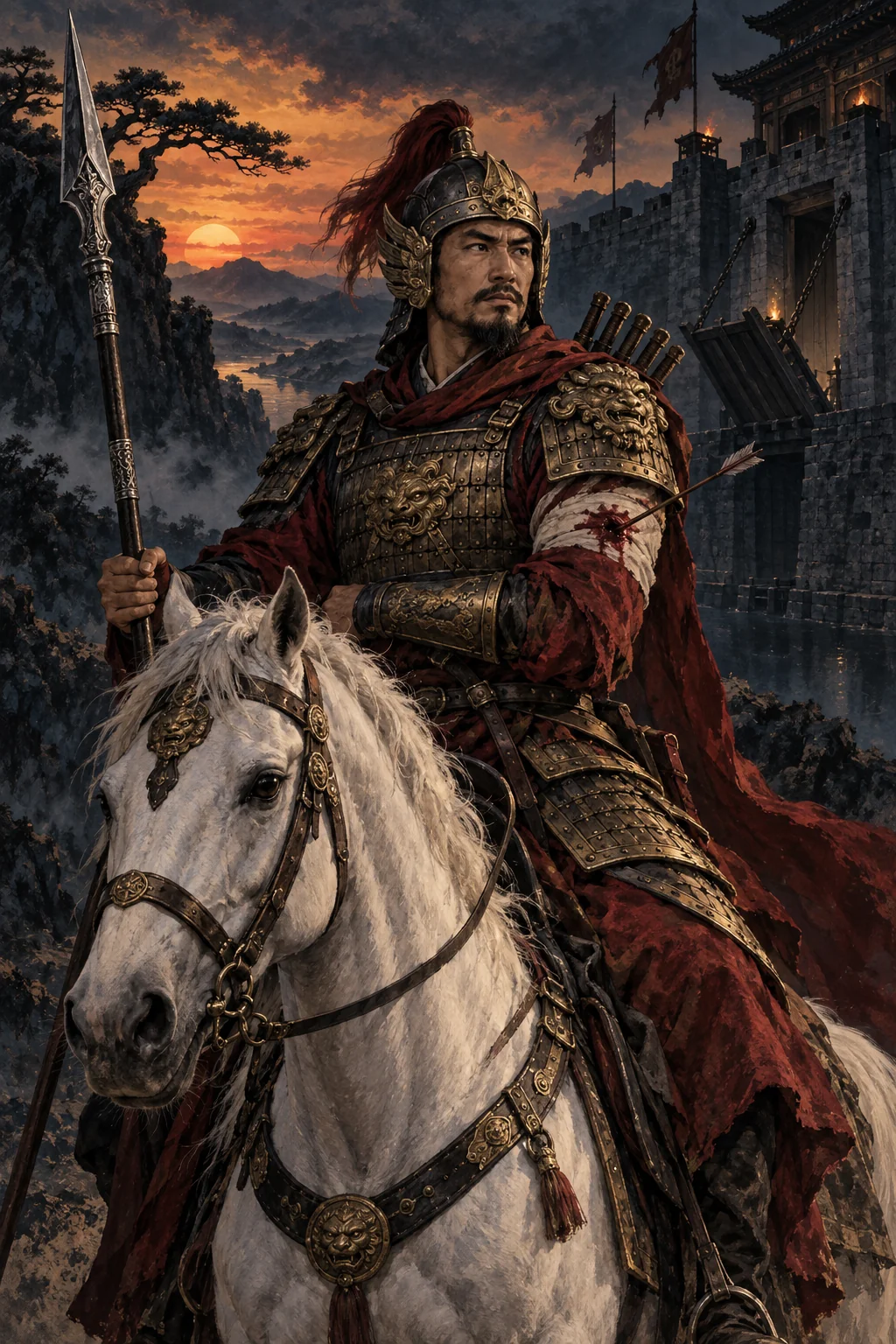
Li Ying controls Li Family Manor at Lone Dragon Ridge. A moat, a drawbridge and racks of weapons make the estate more than a country house. He rides a white horse, carries a steel spear and keeps five throwing knives at his back. People call him Striking Hawk.
The Li, Zhu and Hu households have pledged to protect one another. That arrangement is already under strain when Yang Xiong and Shi Xiu arrive. Shi Qian has been seized at Zhu Family Manor after stealing and cooking an innkeeper’s rooster, then helping burn the inn. Li Ying’s steward Du Xing owes Yang Xiong an old debt and asks his master to intervene.
Li Ying sends a sealed letter requesting Shi Qian’s release. The Zhu brothers reject it. A second messenger returns with Li Ying’s letter torn up and reports that the household has insulted his name. Li Ying has tried to use the authority of a neighbor and ally. The refusal turns the rescue into a test of whether that authority means anything.
The arrow at the drawbridge
He arms three hundred manor workers and rides to the Zhu stronghold. At sunset, he faces Zhu Biao outside its walls. Their spears meet for nearly twenty exchanges. When Zhu Biao turns away, Li Ying follows. Zhu Biao fires backward, and an arrow strikes Li Ying’s left arm. He falls from the white horse.
Yang Xiong and Shi Xiu keep Zhu Biao from reaching him, while Du Xing gets his wounded master back into the saddle. At Li Family Manor, servants remove the arrow and dress the wound. Li Ying gives his guests money for the road to Liangshan, but he does not ride with them.
Song Jiang later comes to Li Family Manor with gifts and a request to meet. Li Ying refuses. His arm is injured, but he also sends a clear message through Du Xing: he will not receive a leader of rebels while the conflict with the neighboring manors is still unfolding. He has broken with the Zhu family without choosing Liangshan.
A rescue that removes the way back
After Zhu Family Manor falls, a prefect arrives at Li Ying’s gate with officers and jailers. He accuses Li Ying of helping Liangshan and accepting its gifts. Li Ying answers that his wound kept him at home and that he knows the law. The officials bind him and Du Xing and lead them toward the prefecture.
Liangshan fighters appear on the road and drive the escort away. Song Jiang urges the two prisoners to stay at the stronghold until the accusation has passed. Li Ying refuses to become an outlaw and says the supposed officials’ fate has nothing to do with him. Surrounded by the returning army, however, he cannot simply turn his horse around.
At Liangshan, Li Ying asks to go home. Wu Yong tells him that his family is already there and that the manor has burned. His wife confirms what happened: another group dressed as officials removed the household, livestock and property, then set the estate on fire. The prefect and officers were Liangshan men in disguise. The rescue on the road was part of the same plan.
Li Ying protests, but the novel gives him no surviving route back to his former life. His family and steward are on the mountain, his property has been taken, and his home is ash. He remains. Chapter 71 later places him eleventh among the 108, under the title Wealth Star.
When help becomes possession
Our reading starts with two forms of obligation. Li Ying first risks his standing because Du Xing asks him to help people linked by an old debt. The Zhu family treats that intervention as betrayal of the manors’ alliance. Liangshan then turns his usefulness and reputation into a reason to take him.
The staged arrest looks like a rescue only while Li Ying believes the threat came from outside. Once he sees the disguised officials and hears what happened at home, rescue and coercion become the same operation. Gratitude cannot be separated from the destruction that produced it.
His later rank may show that he becomes important inside Liangshan. It does not make the first decision free. The burned manor keeps a harder question beside the welcome feast: what does belonging mean when the people offering it have removed every other place to stand?
Can a rescue still be help when it closes every exit?
What part of Li Ying’s story stays with you?
Reading Li Ying.
Why does Li Ying fight Zhu Biao?
Li Ying asks the Zhu family to release Shi Qian, first through one letter and then another. When the Zhu brothers reject the request, tear up his letter and insult him, he rides to their manor. Zhu Biao wounds him in the left arm with an arrow during the fight.
Did Li Ying choose to join Liangshan freely?
The novel shows him refusing. Liangshan members impersonate officials, arrest him, move his family and property, and burn Li Family Manor. With his household already at the stronghold and no home left, he accepts the situation. Calling this a simple voluntary recruitment would hide the coercion.
Published · Updated
Written by Liangshan Lore, based on Water Margin (Shuihu Zhuan), traditionally attributed to Shi Nai’an. The novel follows an outlaw brotherhood in a fictionalized Song-dynasty setting. It is literature, not a record of each character’s historical life.
Chapter references below follow the 120-chapter Chinese edition. Other editions and English translations differ in chapter numbering, names, and endings. These are original English summaries, not quotations from a modern translation. The reflection above is our interpretation. Artwork is a concept illustration.
Continue in English.
These credited resources offer further reading, listening, publication context, or museum evidence. Chinese Lore is an English retelling with transcripts and audio, not a line-by-line translation; podcast episode numbers differ from novel chapters.
Chinese original · text & chapter references
Primary-text references for checking the plot and edition. These pages are in Chinese.