Guo Sheng郭盛
Comparable to Rengui
The river takes his cargo. A rumor leads him toward a rival.
Guo Sheng cannot return home after his mercury boat capsizes. He follows news of another halberd wielder instead—and finds a contest that skill alone cannot finish.
A trade route ends in the Yellow River
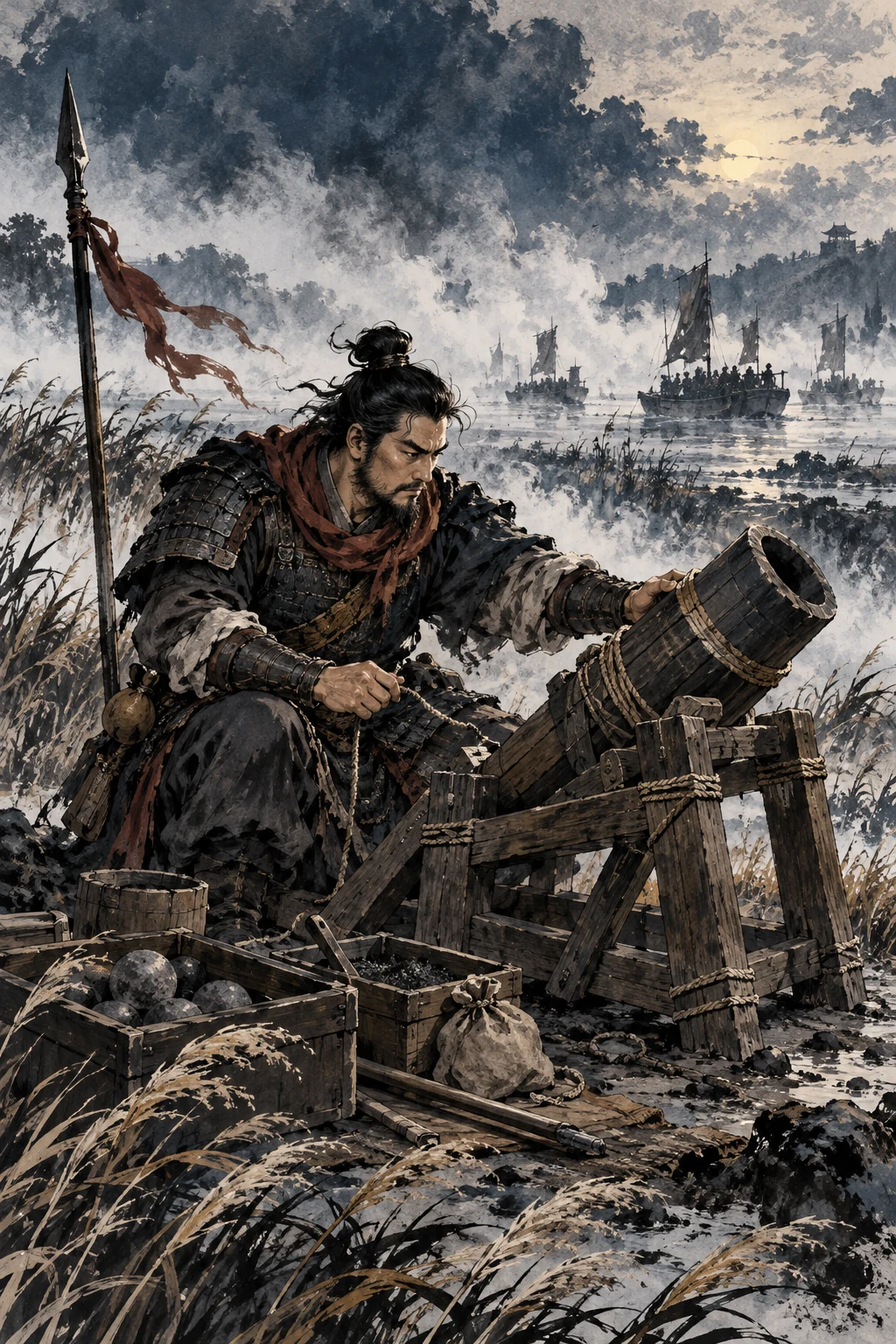
Guo Sheng comes from Jialing in Xichuan and trades in mercury. A storm overturns his boat on the Yellow River. The loss leaves him unable to return home. The novel states the practical result; it does not tell us what he felt as the cargo and the route home disappeared.
He has another trained skill. In Jialing, Guo Sheng learned the fangtian huaji from a military officer named Zhang and became practiced with it. People call him Comparable to Rengui, after Xue Rengui, the early-Tang general remembered in later tradition as a warrior with a halberd.
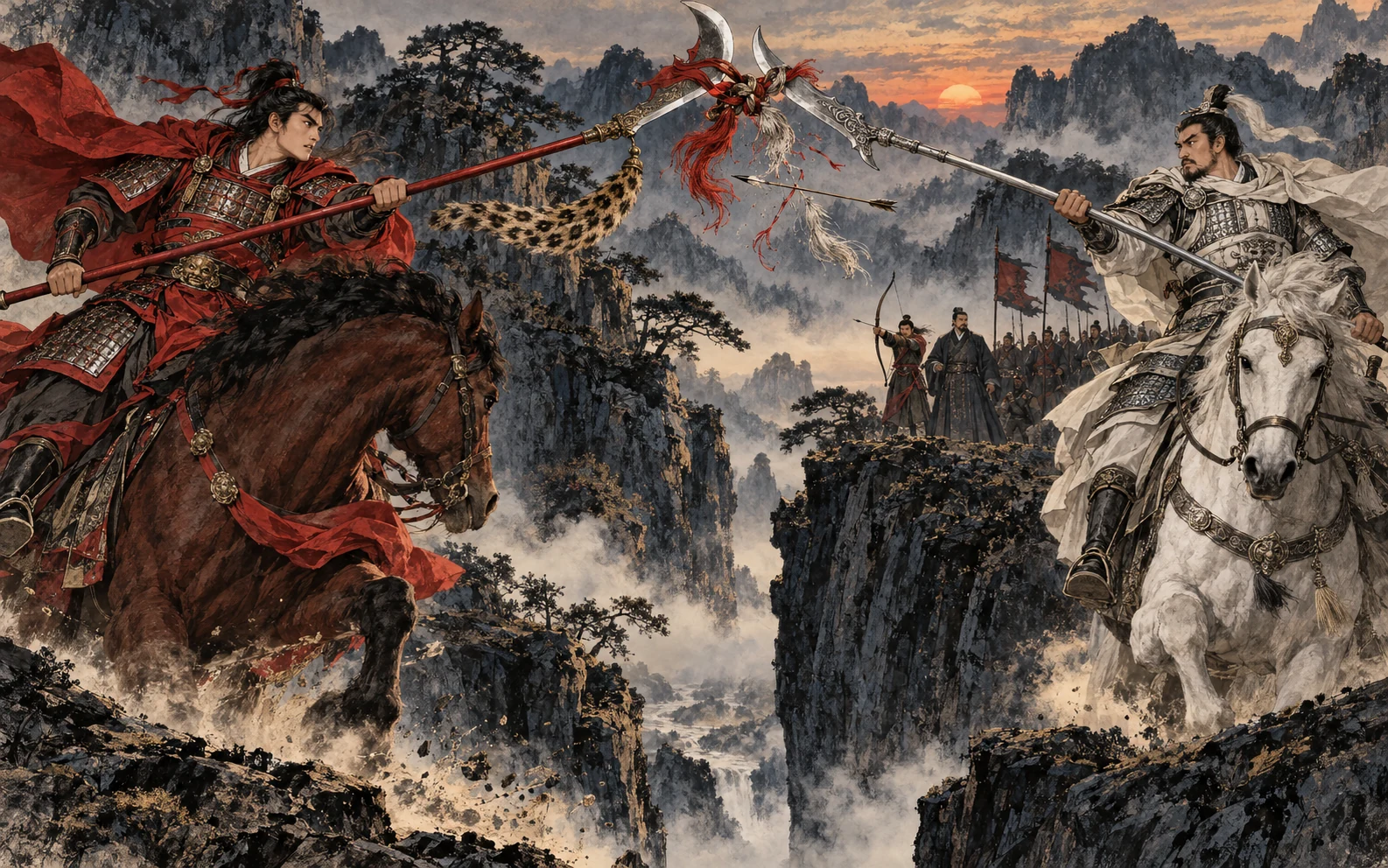
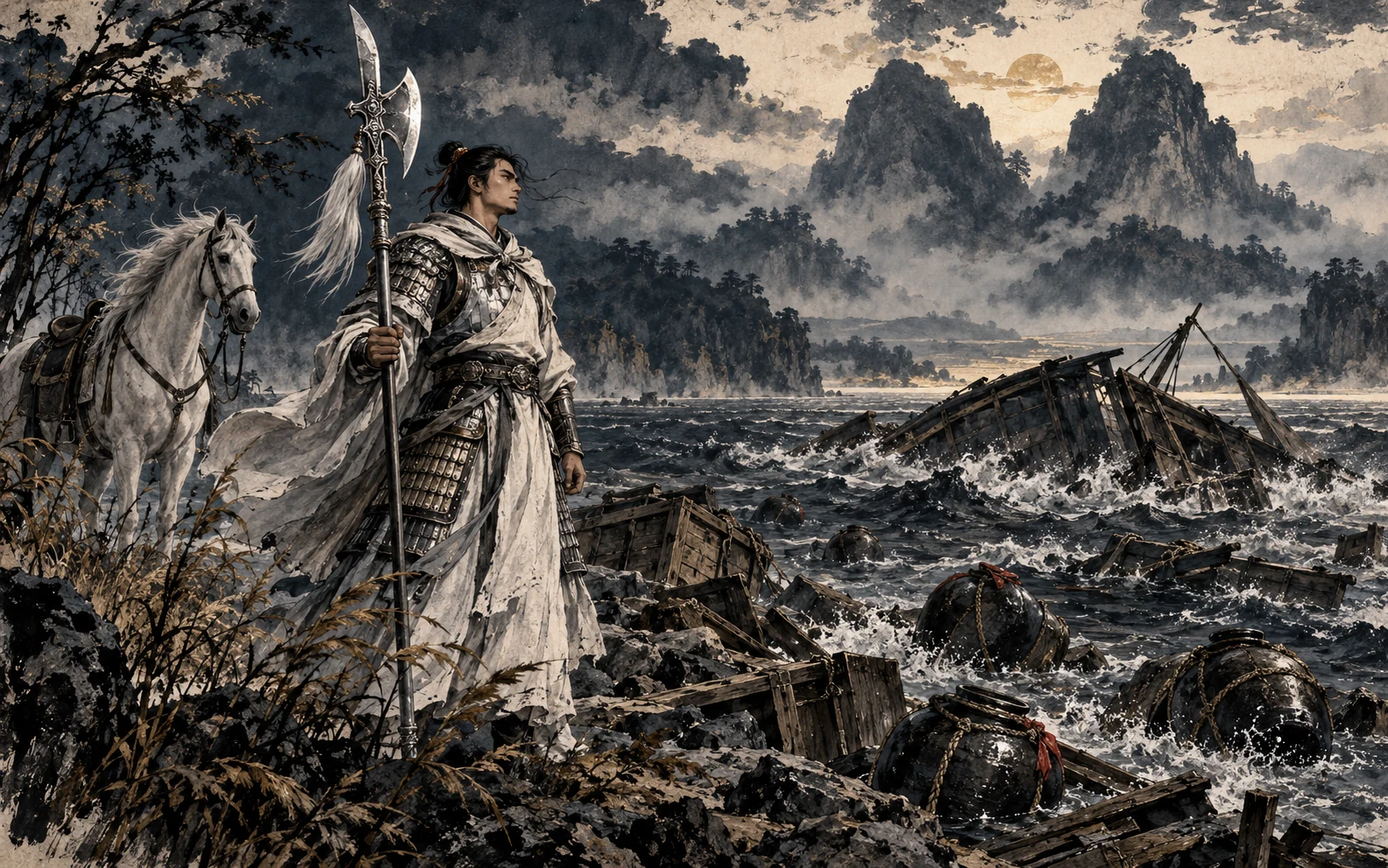
News on the jianghu gives that reputation somewhere to go. Guo Sheng hears that a halberd wielder has occupied Duiying Mountain, so he travels there to compare weapons and take the stronghold. He arrives in white, on a white horse, with a silver halberd and followers dressed to match.
Two reputations caught in one knot
The other warrior is Lü Fang, dressed in red and known through his own comparison with an older general. He offers to divide the paired peaks. Guo Sheng refuses. For more than ten days they ride down to fight, and neither man can force the other to yield.
Song Jiang and Hua Rong encounter the two companies below the mountains. After more than thirty exchanges, the decorations beneath the two halberd blades twist together above the ravine. Equal skill has not settled the dispute; now the weapons themselves cannot separate.
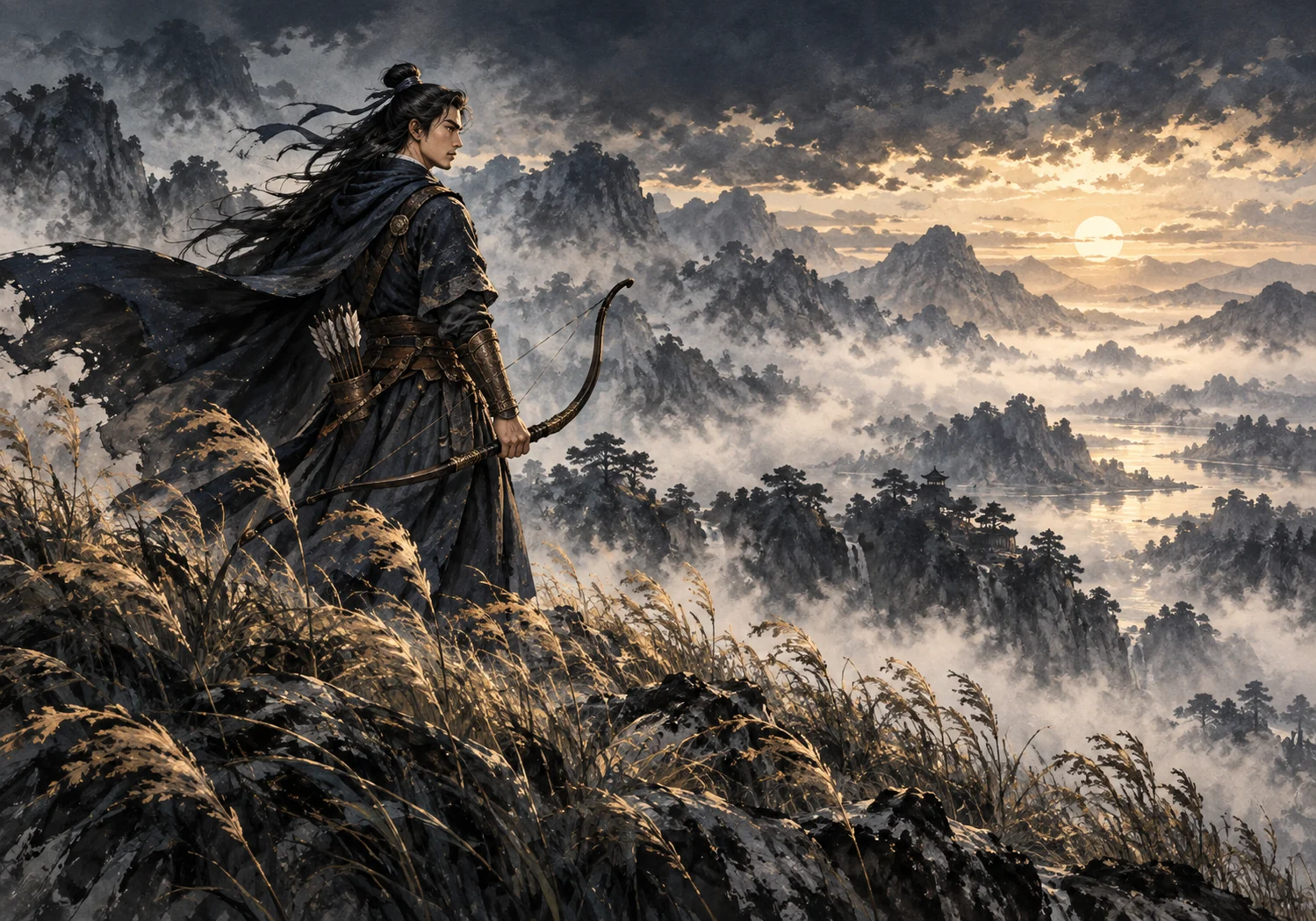
Hua Rong shoots one arrow through the tangled cords and cuts the knot without striking either rider. The two men stop, ask who made the shot and listen to Song Jiang’s proposal for peace. They feast on the separate peaks, gather their people and agree to travel toward Liangshan together.
What a contest cannot prove
Guo Sheng crosses the country because a rumor about someone else’s weapon has become a question about his own standing. The novel gives no judge, rule or finishing condition for that question. Even repeated combat can only produce another day of combat.
The arrow ends the loop by changing the problem. Hua Rong does not name a winner. He creates enough distance for Guo Sheng and Lü Fang to accept another relationship: at Liangshan they rank next to one another and serve together as mounted guards beside Song Jiang and Wu Yong.
At the assembly Guo Sheng ranks fifty-fifth as the Earthly Blessing Star. His skill carries him through later campaigns, but it does not control every danger. At Wulong Ridge, he and Lü Fang lead a charge up the western slope. A large rock falls from above and kills Guo Sheng and his horse before they reach the ridge.
What can skill prove when the contest has no way to end?
What part of Guo Sheng’s story stays with you?
Reading Guo Sheng.
Who is Guo Sheng in Water Margin?
Guo Sheng is a mercury trader from Jialing; Duiying Mountain challenger and Liangshan central-guard cavalry officer, known as Comparable to Rengui. The novel places this character 55 in the assembly of the 108 heroes. That rank is not a judgment of moral worth.
Why is Guo Sheng called Comparable to Rengui?
Guo Sheng is compared with Xue Rengui, a celebrated early-Tang general. The nickname accompanies his training with the fangtian huaji and his white-clad appearance.
Published · Updated
Written by Liangshan Lore, based on Water Margin (Shuihu Zhuan), traditionally attributed to Shi Nai’an. The novel follows an outlaw brotherhood in a fictionalized Song-dynasty setting. It is literature, not a record of each character’s historical life.
Chapter references below follow the 120-chapter Chinese edition. Other editions and English translations differ in chapter numbering, names, and endings. These are original English summaries, not quotations from a modern translation. The reflection above is our interpretation. Artwork is a concept illustration.
Continue in English.
These credited resources offer further reading, listening, publication context, or museum evidence. Chinese Lore is an English retelling with transcripts and audio, not a line-by-line translation; podcast episode numbers differ from novel chapters.
Chinese original · text & chapter references
Primary-text references for checking the plot and edition. These pages are in Chinese.