Gong Wang龚旺
Flowery-Necked Tiger
He throws the weapon in his hand. When it misses, the whole position changes.
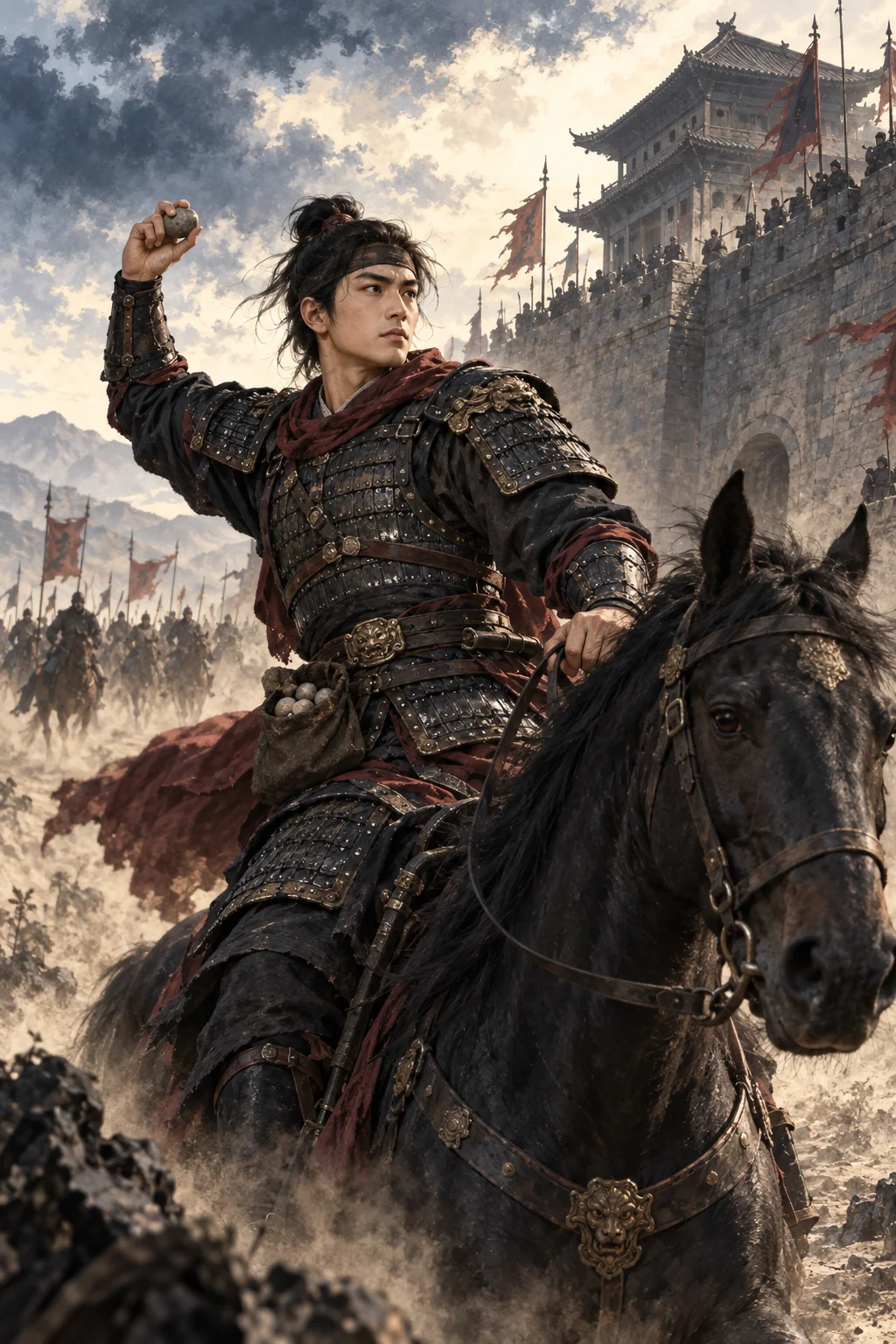
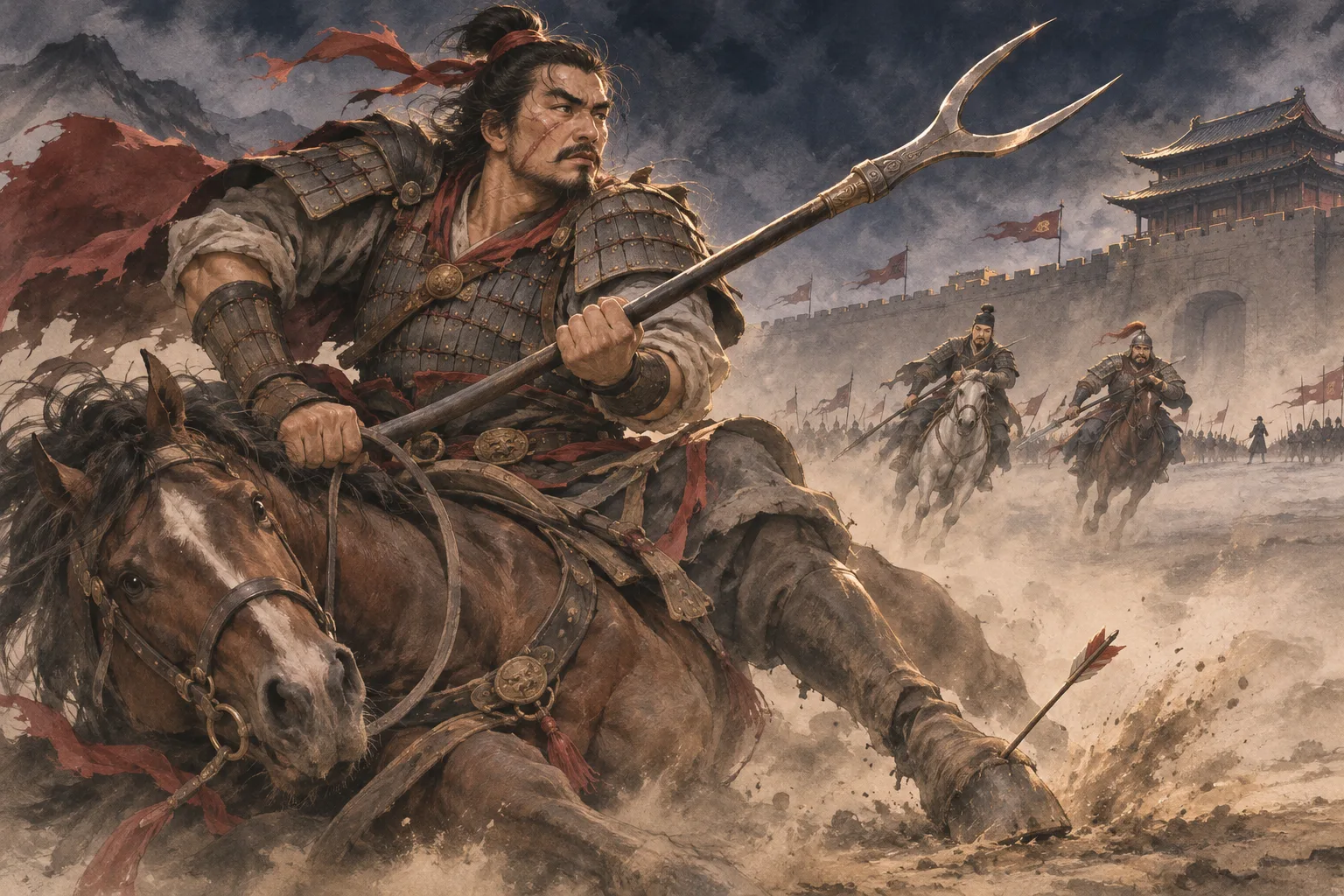
Gong Wang rides behind Zhang Qing at Dongchang, ready to seize the men struck by flying stones. One failed javelin throw leaves the lieutenant with no weapon and two Liangshan fighters closing in.
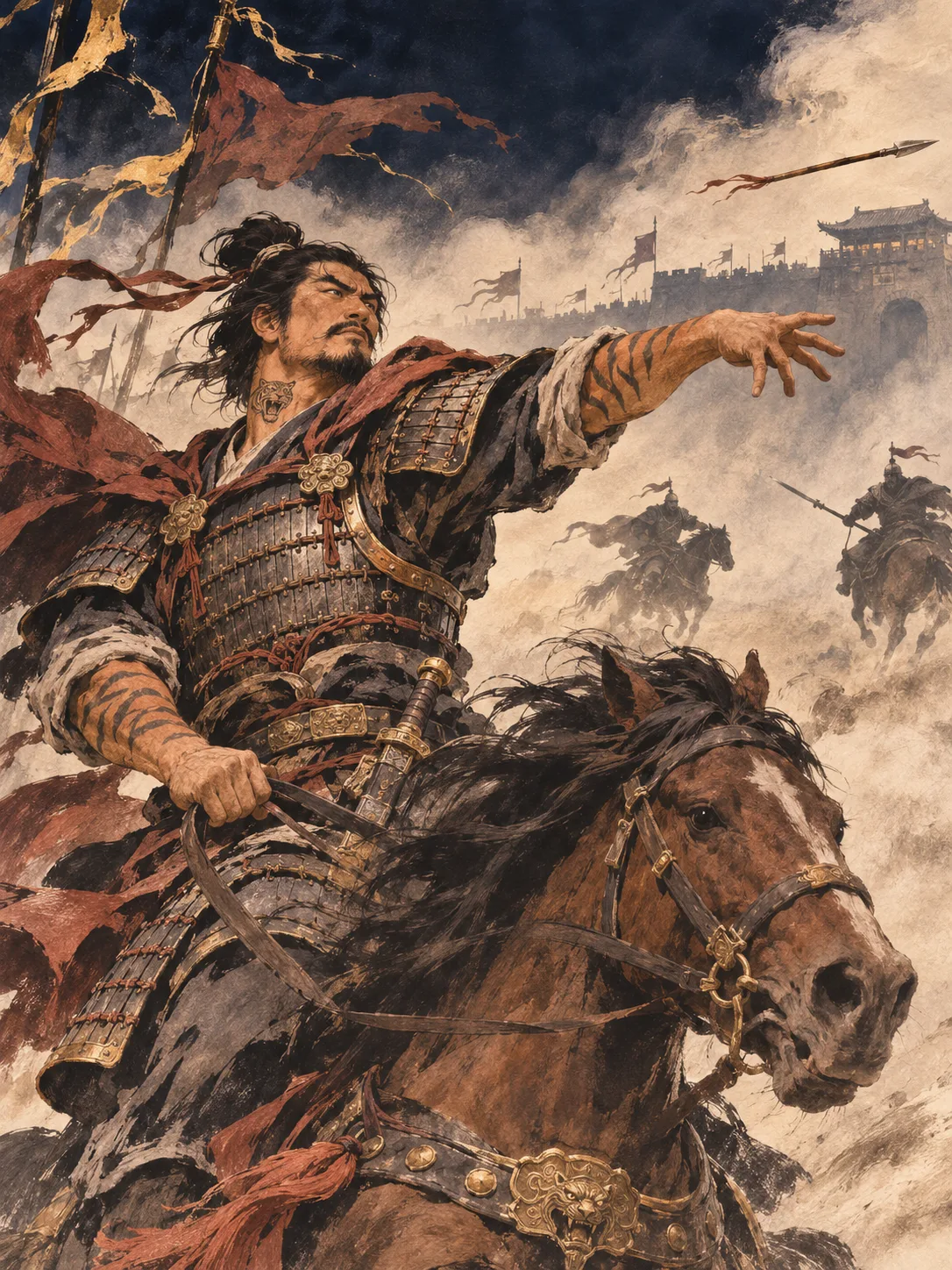
A rider behind the flying stones
Dongchang’s defense is built around Zhang Qing. From horseback, the commander turns small stones into weapons that strike one celebrated Liangshan fighter after another. Gong Wang and Ding Desun serve as his lieutenants, moving in when a stone has broken an opponent’s attack and helping turn an unusual skill into a working battlefield system.
The novel calls Gong Wang the Flowery-Necked Tiger. Tiger stripes are tattooed across his body and a tiger’s head marks his neck. The description makes him visually memorable, but it does not give the tattoos a supernatural force or explain his character through them. His weapon is a short spear or throwing javelin, carried on horseback.
When Zhang Qing wounds Xu Ning with a stone, Gong Wang and Ding Desun rush forward to capture him. Liangshan riders cover the retreat. Gong Wang’s position is therefore not outside Zhang Qing’s spectacle: he is one of the men who must ride into the opening that each successful throw creates.
One throw, then no weapon
As the fight spreads, Gong Wang becomes separated from Zhang Qing and faces Lin Chong and Hua Rong. He throws his javelin at them. It misses. The act meant to stop the closing riders also removes the weapon from his hand.
Lin Chong and Hua Rong take him alive. Gong Wang is sent to Liangshan while the campaign continues. After Zhang Qing is captured and Dongchang falls, Gong Wang and Ding Desun join the brotherhood with their former commander. The text gives no private speech that explains his change of allegiance.
At the great assembly, Gong Wang ranks seventy-eighth as the Earthly Victorious Star and serves among Liangshan’s junior infantry officers. He later scouts and fights beside Zhang Qing and Ding Desun against Tong Guan’s imperial army. The former supporting trio remains visible inside a much larger force.
The person beside the spectacle
Zhang Qing’s stones dominate the Dongchang episode, but a spectacular weapon still needs other people to finish what it starts. Gong Wang’s supporting role asks him to enter the most exposed part of the encounter. He does not control the whole defense, yet he bears the full risk of the moment when he advances.
The failed throw is a compact reversal. Commitment gives the javelin its force; the same commitment means it cannot protect him after it has passed wide. This is an interpretation of the scene, not a claim that the novel records his thoughts.
Years later at Deqing, Gong Wang fights Huang Ai during the Fang La campaign. He pursues the retreating officer across a stream, where horse and rider fall. Enemy soldiers close in and stab him to death. The report reaches Song Jiang through Huyan Zhuo. Once again, forward movement changes into exposure before the men around him can recover the position.
What does a supporting role ask of the person who cannot control the whole plan?
What part of Gong Wang’s story stays with you?
Reading Gong Wang.
Who is Gong Wang in Water Margin?
Gong Wang is a dongchang lieutenant, mounted javelin fighter and Liangshan infantry officer, known as Flowery-Necked Tiger. The novel places this character 78 in the assembly of the 108 heroes. That rank is not a judgment of moral worth.
How does Gong Wang die in Water Margin?
During the Fang La campaign at Deqing, Gong Wang pursues Huang Ai across a stream. His horse falls in the water, and enemy soldiers close in and stab him to death.
Published · Updated
Written by Liangshan Lore, based on Water Margin (Shuihu Zhuan), traditionally attributed to Shi Nai’an. The novel follows an outlaw brotherhood in a fictionalized Song-dynasty setting. It is literature, not a record of each character’s historical life.
Chapter references below follow the 120-chapter Chinese edition. Other editions and English translations differ in chapter numbering, names, and endings. These are original English summaries, not quotations from a modern translation. The reflection above is our interpretation. Artwork is a concept illustration.
Continue in English.
These credited resources offer further reading, listening, publication context, or museum evidence. Chinese Lore is an English retelling with transcripts and audio, not a line-by-line translation; podcast episode numbers differ from novel chapters.
Chinese original · text & chapter references
Primary-text references for checking the plot and edition. These pages are in Chinese.