Why Did Liangshan Accept Imperial Amnesty?
Liangshan can defeat armies sent against it. Song Jiang still wants an imperial edict. To him, victory outside the law remains incomplete; to some companions, returning to the court looks like surrender.
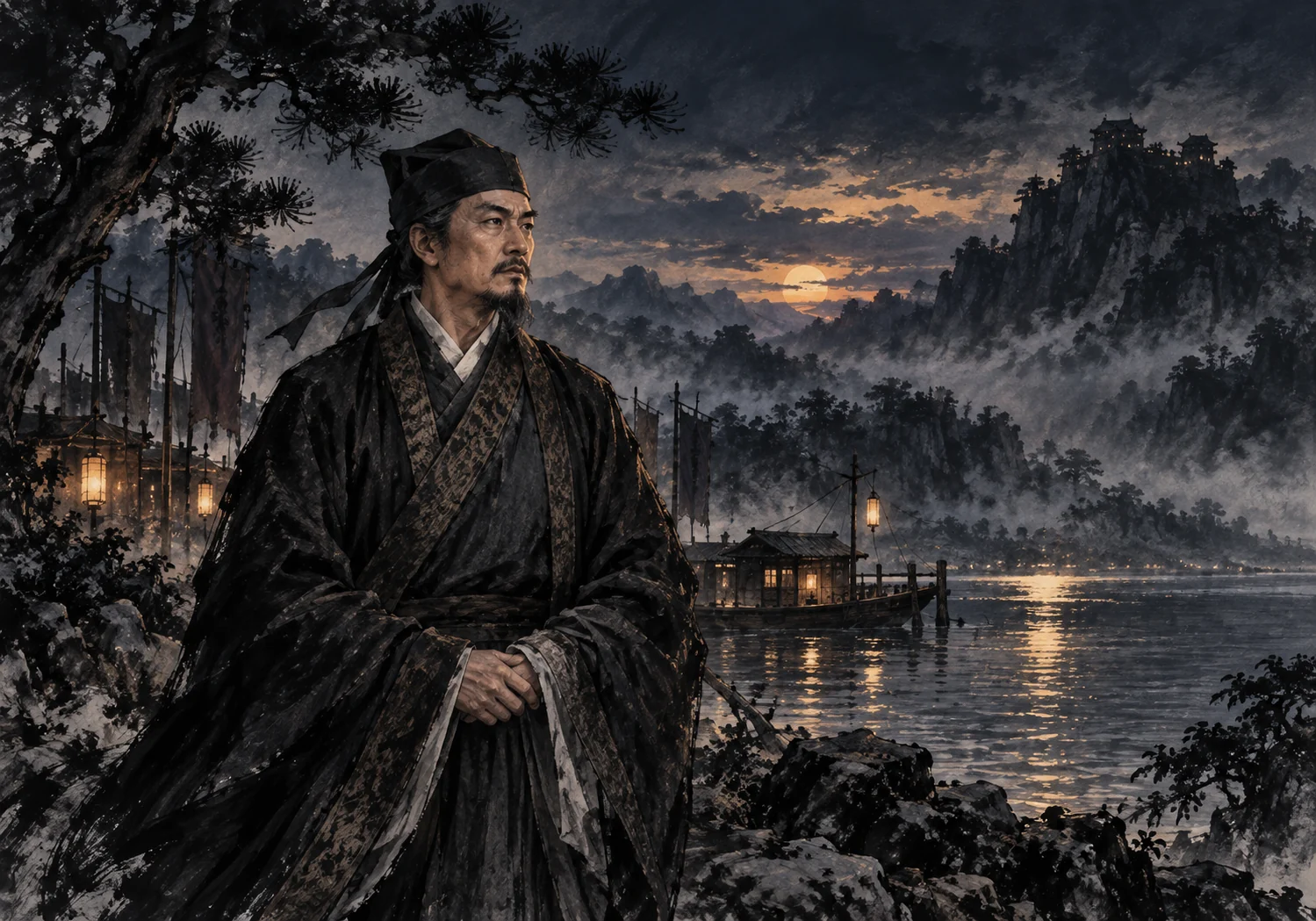
Zhao’an offers recognition, not simple forgiveness
Zhao’an (招安) is usually translated as amnesty, pacification, or recruitment by the state. In the novel, it means that the court accepts the Liangshan company into imperial service rather than continuing to treat it only as a bandit enemy.
The offer can clear legal status and create official roles, but it is not retirement. Acceptance places the outlaws under command and sends them to fight wars and other rebel forces. The route back into the state is also a route onto new battlefields.
Song Jiang never treats outlaw rule as the final destination
Song Jiang’s language repeatedly joins loyalty to companions with loyalty to the dynasty. He condemns corrupt ministers more readily than the emperor or imperial order. Even at the height of Liangshan’s power, he imagines recognition that will convert the company’s deeds into legitimate service.
This ambition fits his earlier life. He begins as a county clerk with deep knowledge of official society, not as someone seeking to abolish it. Becoming an outlaw solves his immediate survival problem without erasing the values by which he wants his name judged.
The brotherhood does not speak with one voice
The first amnesty attempt fails amid arrogance, mistrust, and conflict. Li Kui tears the edict and curses the envoy. Other members also doubt the court or the terms being offered. Their resistance is not irrational: many reached Liangshan because officials abused, framed, or tried to kill them.
Song Jiang continues through court contacts and Yan Qing’s access to the emperor. Military victories strengthen Liangshan’s bargaining position. The final acceptance in Chapter 82 follows negotiation, display, and pressure—not a sudden shared faith in government.
Official service gives status and consumes the company
After the edict, the Liangshan forces leave their independent stronghold and fight on behalf of the court. The campaigns differ by edition. In the 120-chapter version they include wars against Liao and the forces of Tian Hu, Wang Qing, and Fang La.
Recognition does not protect the brotherhood from attrition or political hostility. Companions die in battle, illness, accidents, and the aftermath. Those who survive do not all choose the same relationship to office.
Amnesty answers one question by creating another
If the goal is to remove the bandit label and serve a legitimate dynasty, Song Jiang succeeds. If the goal is to preserve the community assembled at Liangshan, the decision is devastating. The same outcome can look like moral completion, political capture, or tragic consistency.
The novel does not let readers preserve a pure fantasy of permanent freedom. The brotherhood becomes powerful enough to force recognition, then enters the order whose failures made the brotherhood necessary.
Is recognition still a victory when it requires giving up the world that made it possible?
Which part of the story speaks to you? Tell us as we shape the complete 108-card collection.
Original English writing by Liangshan Lore, based on the Chinese novel Water Margin, traditionally attributed to Shi Nai’an. Plot references follow the 120-chapter Chinese edition; names, chapter numbering, and endings can vary between editions and translations. Sections marked “Our reading of the story” offer our interpretation. The characters and events belong to fiction; concept illustrations are not historical portraits.
Continue in English.
These credited resources offer further reading, listening, publication context, or museum evidence. Chinese Lore is an English retelling with transcripts and audio, not a line-by-line translation; podcast episode numbers differ from novel chapters. CUHK Press links introduce published English translations.
Chinese original · text & chapter references
Primary-text references for checking the plot and edition. These pages are in Chinese.
Song JiangTimely Rain · illustrated character story Yan QingThe Wanderer · illustrated character story