A Map of Water Margin’s Story World
The story world is not one marsh and one capital. It is a chain of cities, prisons, estates, temples, ferries, mountain refuges, and roadside inns where official reach competes with local knowledge.
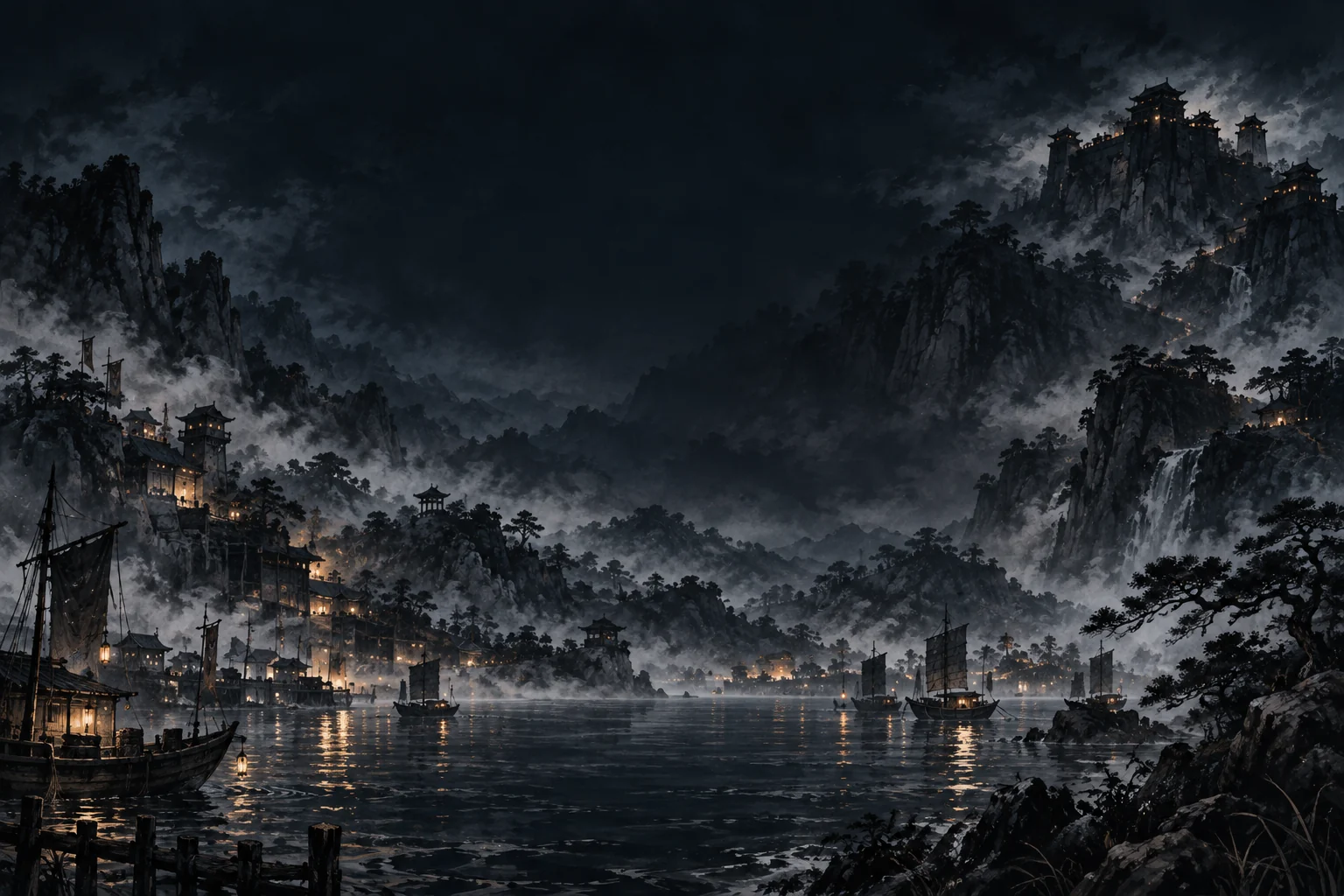
Bianjing is the center of authority and distance
The Northern Song capital, Bianjing—present-day Kaifeng—is where Gao Qiu rises and where imperial decisions are imagined to begin. It is also a place the outlaws approach indirectly, through officials, envoys, performers, courtesans, and Yan Qing’s eventual access to Emperor Huizong.
The capital is powerful without being everywhere. Provincial actors interpret, delay, sell, and weaponize its authority.
Shandong holds the marsh and many routes into it
Liangshan Marsh belongs to the story’s Shandong landscape. Nearby counties, manors, market towns, landing places, and smaller strongholds create a zone where news and armed groups move repeatedly. The Zhu Family Manor campaigns show that local estates can command defenses and alliances of their own.
Qingzhou connects several mountain bands and former officers. Daming, called Beijing in the novel’s administrative geography, becomes the site of Lu Junyi’s imprisonment and a major Liangshan assault.
Cangzhou and Jiangzhou turn punishment into travel
Lin Chong is sent toward Cangzhou; Song Jiang is exiled to Jiangzhou. A sentence changes more than legal status. It places a prisoner on roads controlled by escorts, exposes him to inns and patrons, and transfers him into a new local system of guards and officials.
The route can be more dangerous than the destination. Wild Boar Forest, river boats, crossroads, and taverns repeatedly become places where a legal journey can turn into murder or rescue.
The geography organizes movement without behaving like modern navigation
Place names mix historical geography, literary convention, and the practical needs of a long narrative. Travel time is often subordinate to episode rhythm. A map can clarify regions and routes, but it should not be used to prove that every journey follows a precise measurable itinerary.
The useful question is relational: who controls the gate, road, river, inn, or pass? The answer explains how power changes from one place to the next.
Who holds power when authority must travel farther than friendship and local knowledge?
Which part of the story speaks to you? Tell us as we shape the complete 108-card collection.
Original English writing by Liangshan Lore, based on the Chinese novel Water Margin, traditionally attributed to Shi Nai’an. Plot references follow the 120-chapter Chinese edition; names, chapter numbering, and endings can vary between editions and translations. Sections marked “Our reading of the story” offer our interpretation. The characters and events belong to fiction; concept illustrations are not historical portraits.
Continue in English.
These credited resources offer further reading, listening, publication context, or museum evidence. Chinese Lore is an English retelling with transcripts and audio, not a line-by-line translation; podcast episode numbers differ from novel chapters. CUHK Press links introduce published English translations.
Chinese original · text & chapter references
Primary-text references for checking the plot and edition. These pages are in Chinese.
 Chai JinLittle Whirlwind · illustrated character story
 Song JiangTimely Rain · illustrated character story