Hou Jian侯健
Long-Armed Ape
He enters to make clothes. He leaves with the knowledge an attack needs.
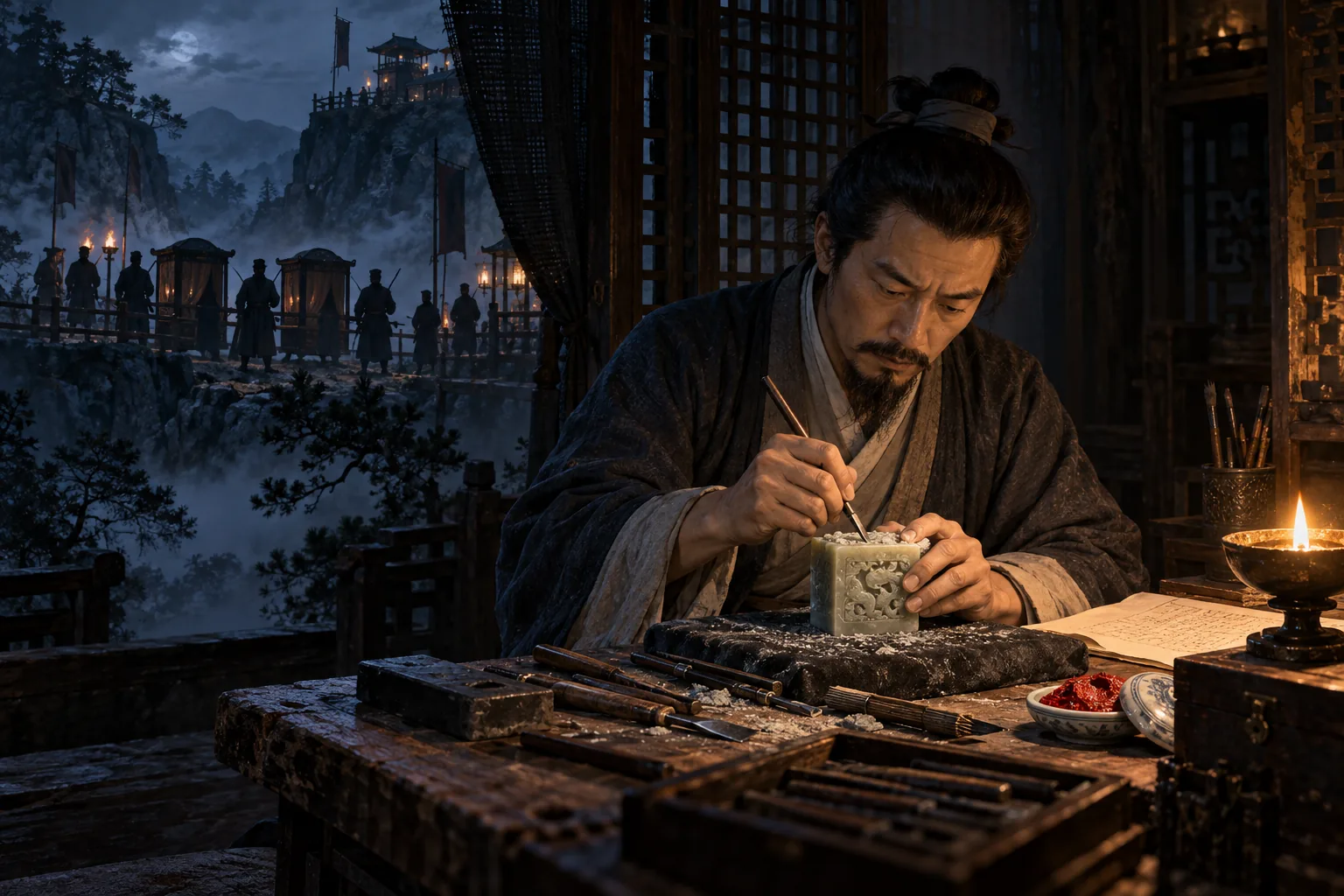
Hou Jian is hired as a tailor inside Huang Wenbing’s home. Needles and thread give him access to rooms, routes and talk that become intelligence for Song Jiang’s revenge.
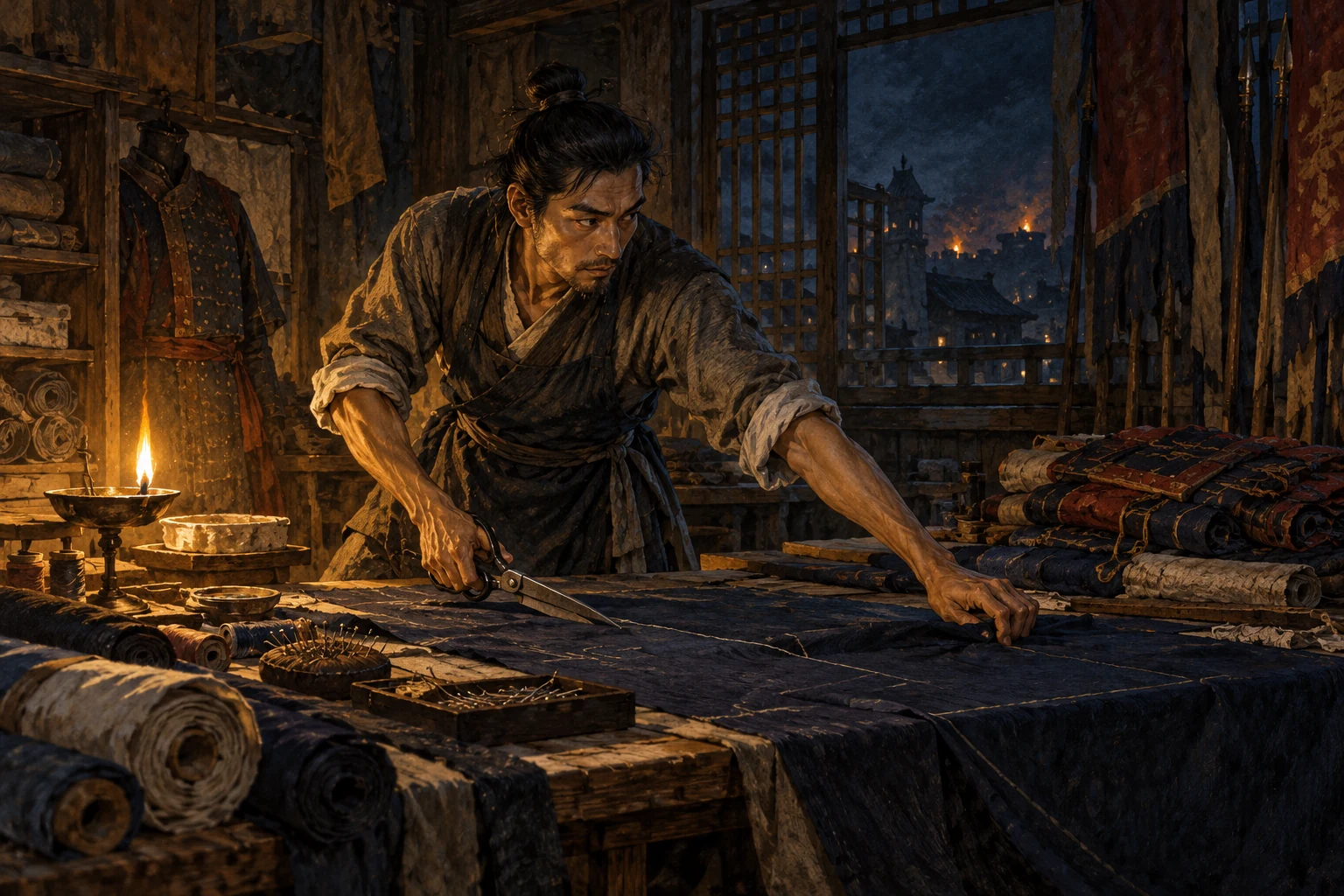
A tailor crosses a guarded threshold
Hou Jian comes from Hongdu and is introduced as a first-rate tailor whose needle and thread seem to fly. He is lean, dark-complexioned and quick, which gives him the name Long-Armed Ape. He can also use spear and staff and has studied fighting under Xue Yong.
Those abilities do not bring him into the story through a duel. Huang Wenbing hires him to make clothes in the household at Wuwei. The commission places a working craftsman inside a private space at the moment Song Jiang’s rescuers need local knowledge.
When Hou Jian meets Xue Yong outside, he learns of Song Jiang and asks to make contact. He reports what he has heard in the house: Huang Wenbing pressed the Jiangzhou prefect to execute Song Jiang and Dai Zong, the city is on alert, and Huang is temporarily away. He also explains the layout—Huang’s brother lives nearby, with a vegetable garden between the two homes.
Information becomes an entry plan
Song Jiang uses the report to plan the attack on Wuwei. Hou Jian, Xue Yong and Bai Sheng enter the city first. At the appointed signal, Hou Jian opens the garden gate so bundles of reeds can be carried inside. He then helps create the fire that draws Huang Wenbing’s household to its door.
The operation kills Huang Wenbing’s household and burns the property. The novel distinguishes the elder brother’s household and tells the attackers not to harm it, but that boundary does not make the raid bloodless: dozens of people in the targeted home are killed. Hou Jian’s accurate access helps make the violence possible.
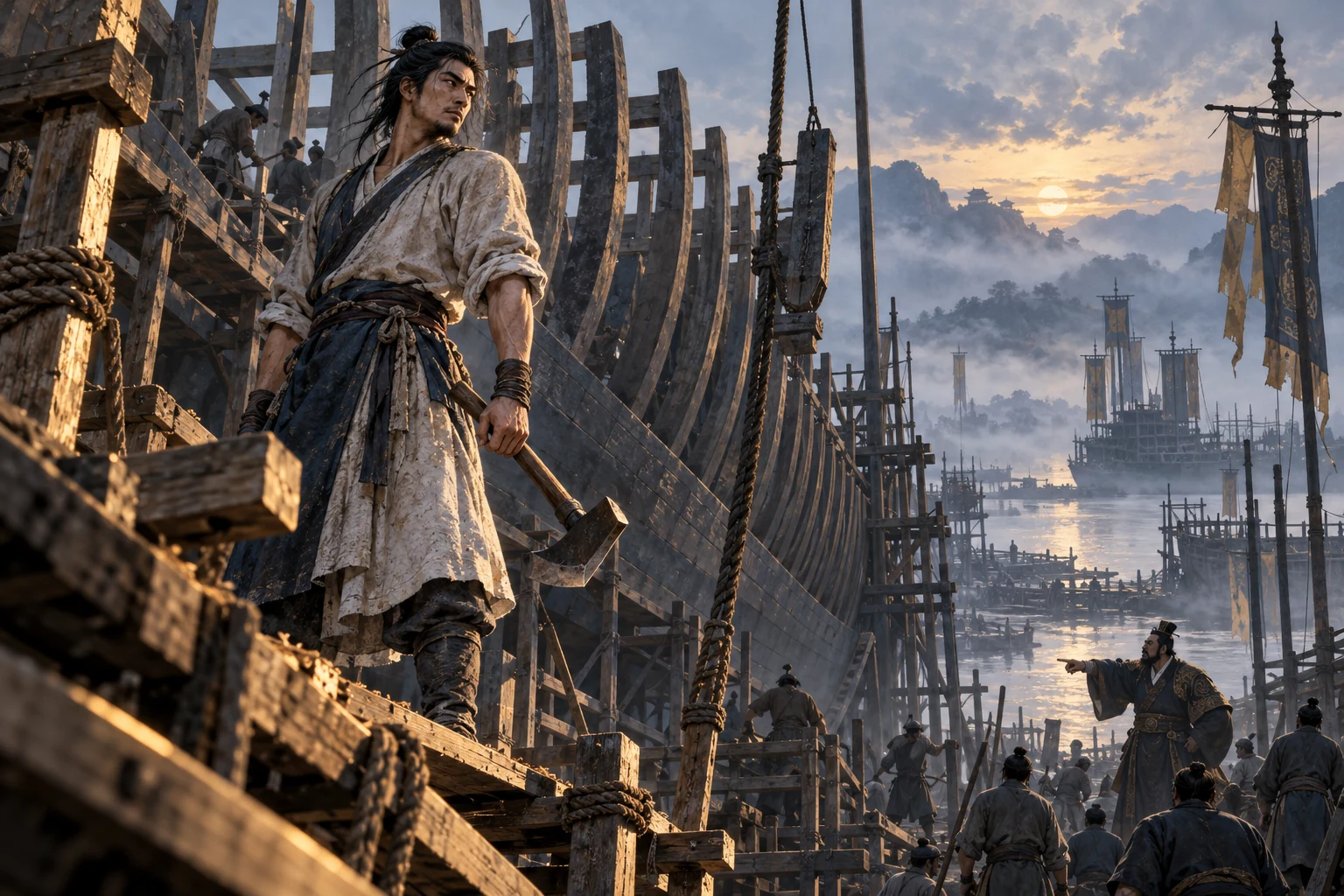
Hou Jian leaves with the returning company and joins Liangshan. At the great assembly he ranks seventy-first as the Earthly Accomplished Star. His formal responsibility returns to the skill that first carried him across the threshold: he makes the stronghold’s banners and military robes.
What a craft lets you see
Tailoring looks like background work until the story shows what it can open. A client admits the tailor because clothes must be measured, cut and fitted. Hou Jian’s labor creates proximity, and proximity creates knowledge that armed men outside the walls do not have.
The sequence does not make that knowledge morally neutral. Hou Jian helps expose a man who has tried to secure two executions, but the resulting revenge extends through an entire household. Knowing where the gate stands and when a client is absent does not decide what should be done with that knowledge.
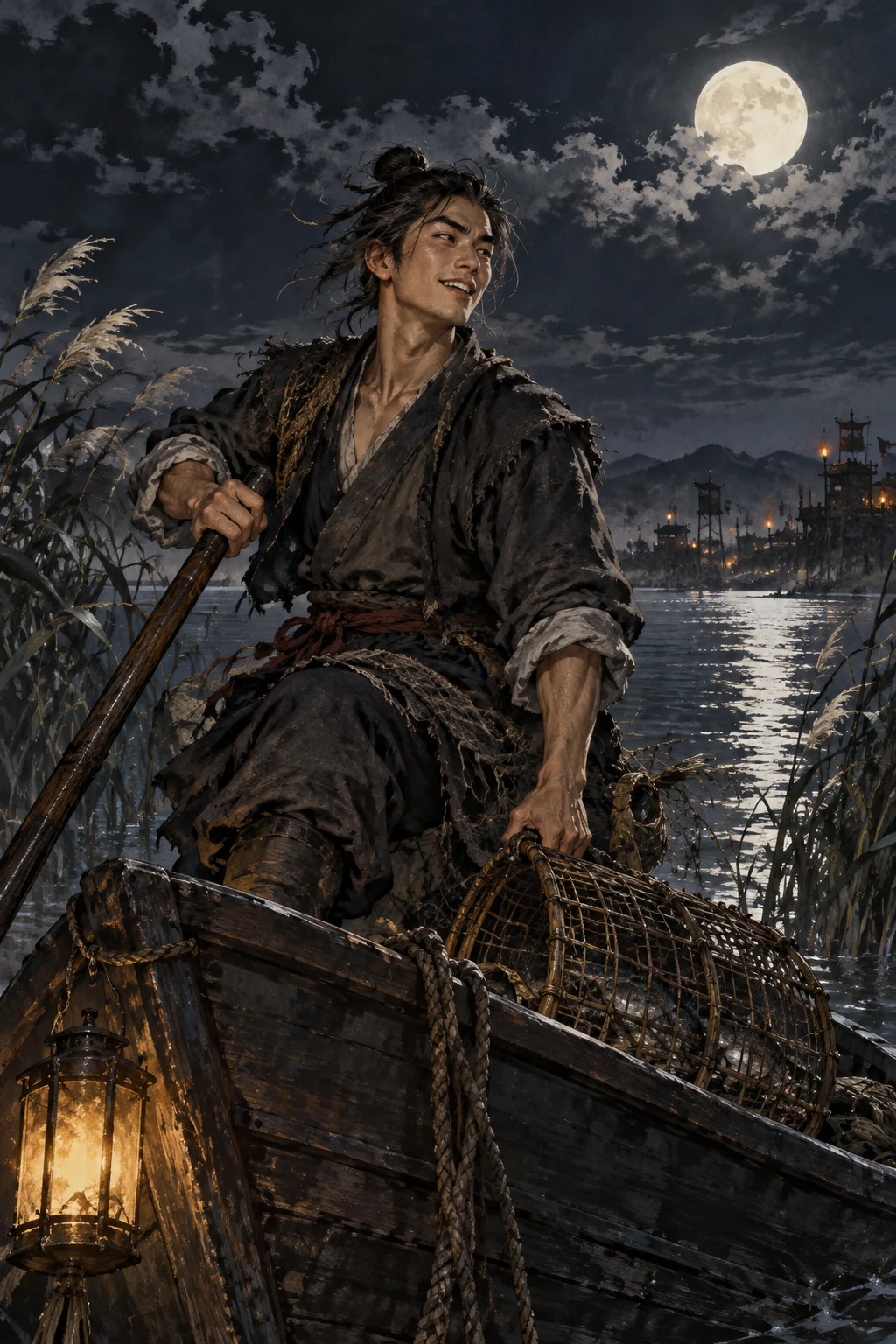
Late in the Fang La campaign, Hou Jian joins Zhang Heng, Ruan Xiaoqi and Duan Jingzhu on a coastal boat mission. Wind drives the vessel out to sea and then breaks it. Chapter 116 says that Hou Jian and Duan Jingzhu cannot swim and drown. The man whose craft supplied an army with visible identity dies beyond the reach of those banners, in water where his trained hands cannot save him.
What responsibility comes with access earned through ordinary work?
What part of Hou Jian’s story stays with you?
Reading Hou Jian.
Who is Hou Jian in Water Margin?
Hou Jian is a tailor from Hongdu, Xue Yong’s student and Liangshan maker of banners and robes, known as Long-Armed Ape. The novel places this character 71 in the assembly of the 108 heroes. That rank is not a judgment of moral worth.
What does Hou Jian do at Liangshan?
After the assembly, Hou Jian is assigned to make banners and military robes for Liangshan. He is ranked seventy-first and called the Long-Armed Ape.
Published · Updated
Written by Liangshan Lore, based on Water Margin (Shuihu Zhuan), traditionally attributed to Shi Nai’an. The novel follows an outlaw brotherhood in a fictionalized Song-dynasty setting. It is literature, not a record of each character’s historical life.
Chapter references below follow the 120-chapter Chinese edition. Other editions and English translations differ in chapter numbering, names, and endings. These are original English summaries, not quotations from a modern translation. The reflection above is our interpretation. Artwork is a concept illustration.
Continue in English.
These credited resources offer further reading, listening, publication context, or museum evidence. Chinese Lore is an English retelling with transcripts and audio, not a line-by-line translation; podcast episode numbers differ from novel chapters.
Chinese original · text & chapter references
Primary-text references for checking the plot and edition. These pages are in Chinese.